


If you are considering a mediumship reading, the choice between an online session and meeting in person may feel important. You might prefer the familiarity of home, the ease of a phone conversation or sharing a room with the reader.
Choose around those practical preferences. Neither distance nor physical presence establishes spirit contact, and neither format guarantees comfort, closure or accuracy. You can welcome spiritual meaning while keeping your right to question what is said and decide whether to proceed.
Separate the method from the delivery
Mediumship concerns claimed communication with people who have died. Phone, video, live chat, email and in-person appointments describe how the conversation or response reaches you. A reader may offer only some of those arrangements.
A video session is live but depends on a connection and a private place. A written reading may arrive later and offer limited follow-up. Check the actual service rather than treating “online” as one standard experience. The remote-format guide explains those distinctions in more detail.
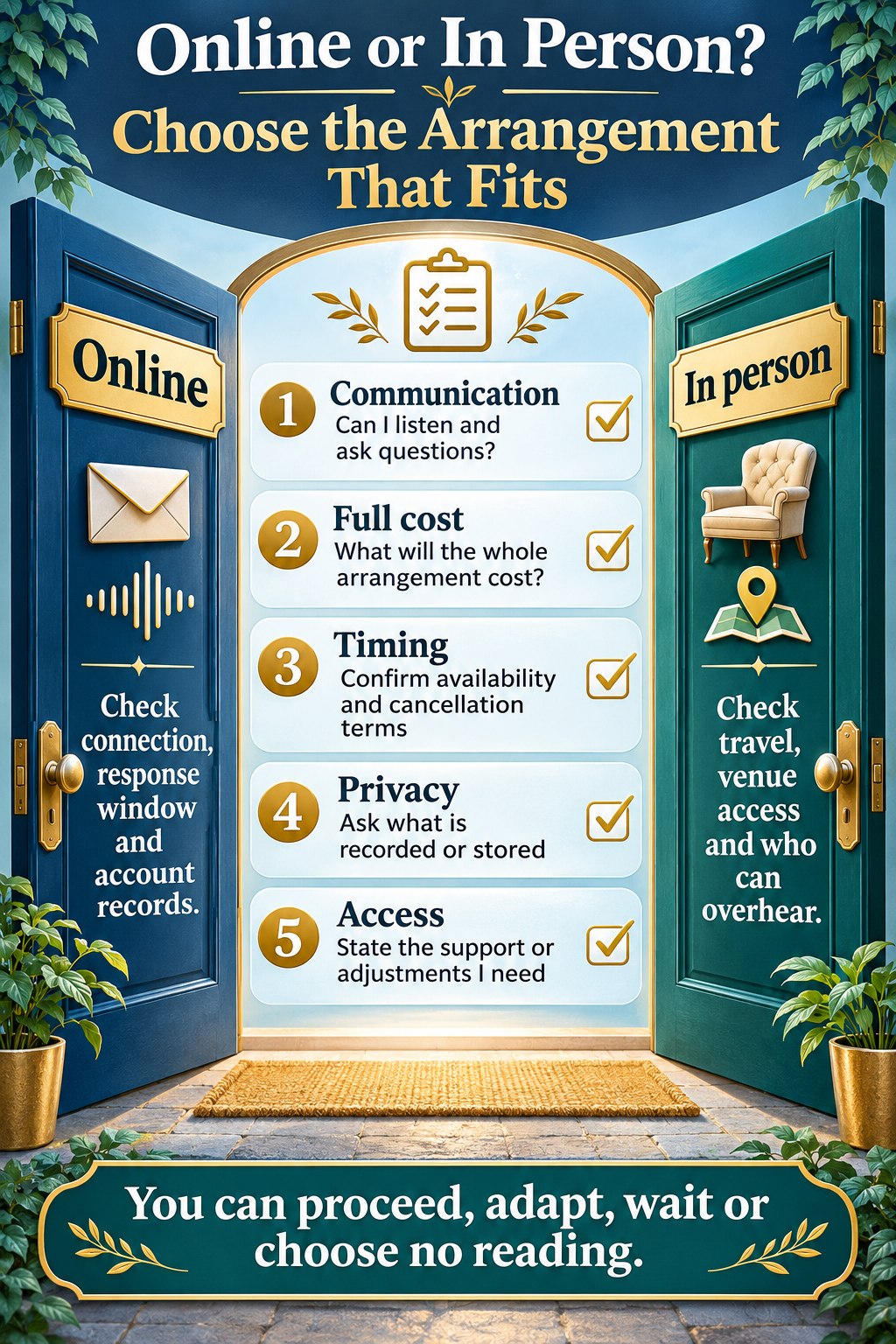
Five factors to compare for either arrangement
1. Comfort and communication
Online: you may prefer familiar surroundings, a camera-free call or written text.
In person: you may prefer direct conversation in the same room.
Ask: what helps me listen, ask questions and end when I need to?
2. The complete cost
Online: check per-minute, fixed-session or written-package charges and extras.
In person: check appointment scope, price and travel costs.
Ask: what will this specific arrangement cost within my limit?
3. Timing and availability
Online: confirm the reader’s status, time zone or written-response window.
In person: confirm the venue, appointment and cancellation terms.
Ask: what happens if the reader, connection or travel plan changes?
4. Privacy and records
Online: consider notifications, your surroundings, account data and saved transcripts.
In person: check whether others can overhear and what notes or recordings remain.
Ask: who can see or hear this, and what will be stored?
5. Accessibility and practical support
For remote arrangements, check typing, audio, captions if available, device requirements and connection. For a venue, check travel, entrance, seating, breaks and communication needs. Ask whether a support person may attend if that matters to you. Neither format automatically meets every access need.

What a session may involve
A reader may introduce their approach, agree on the scope and describe impressions they interpret as messages. You can ask for a plain explanation, say a detail does not fit or decline a subject. An in-person setting does not make touch necessary; a reader should ask before any physical contact.
Some people value a calm atmosphere or familiar surroundings, but atmosphere is different from verification. Nonverbal cues, shared information, expectations and ordinary conversation can influence an exchange in person or remotely. You do not need to blame yourself if a session feels vague or unhelpful.
No reader can guarantee that a particular deceased person will appear. A lack of a message does not establish that your loved one is upset or that you need further paid sessions. Your bond does not depend on buying a reading.
Free format-choice worksheet
Use the same questions for two arrangements you are considering. Copy the prompts into a private note.
- My purpose: what kind of spiritual conversation am I choosing?
- My must-have: a written response, a camera-free call, accessible venue or another specific requirement.
- My limit: maximum time, total spend and information I will not share.
- Arrangement A: format, full cost, timing, privacy, access and terms for stopping.
- Arrangement B: the same details, without assuming one is automatically better.
- Unanswered questions: what do I need to ask before paying?
- My choice: proceed, adapt, wait or choose no reading.
Example: “I want to speak without a camera, have limited travel options and need a clear stopping point. I will compare two phone arrangements, ask about records and agree on the total before booking.”
Prepare without giving away more than you choose
Find a comfortable setting and leave room afterward for an ordinary break. State your purpose and boundaries. You do not need to assemble another person’s private family history or accept an interpretation because a reader sounds certain.
If you want notes or a recording, ask before recording and follow the relevant agreement and rules. A saved transcript can help you review what was actually said; it does not itself establish accuracy. Our session-preparation guide offers a more detailed checklist.
Read reviews as accounts of service
Look for specific comments about communication, punctuality, costs and how concerns were handled. A story of comfort does not guarantee the same response for you, and a testimonial is not proof of contact.
Be alert to pressure, threats, secrecy or a claim that urgent extra payment is needed to help a spirit. The FTC’s scam guidance explains common pressure and payment warning signs. Evaluate the conduct in front of you rather than assuming one format is free of risk.
Leave space for support beyond a reading
A mediumship session is optional. Grief can include many feelings, and you do not need to seek closure on a reader’s schedule. The NHS guide to grief and bereavement outlines support when coping feels difficult.
Choose the arrangement that fits your actual needs and terms—or defer. Spiritual interest does not require booking immediately, spending beyond your means or continuing a conversation you want to leave.
Frequently asked questions
1. Are online or in-person mediumship readings better?
There is no universal best arrangement. Compare the particular service with your comfort, costs, privacy, timing and access needs.
2. Does an in-person meeting prove a stronger spirit connection?
Physical presence does not establish contact or verify an interpretation. You may prefer the atmosphere without treating it as proof.
3. Does distance make a remote reading more accurate?
The delivery format does not establish accuracy. Ordinary information, expectations and communication can influence either kind of session.
4. Are all online readings live?
No. Phone, video and chat may be live, while a written reading can have a later response window and different follow-up terms.
5. Are online sessions always cheaper?
No. Compare full prices, charging basis, minimums, extras and any travel costs for the actual arrangements.
6. Can I reach any medium at any time online?
No. A platform’s general availability does not guarantee that a specific reader is free. Check current status, appointment details or delivery time.
7. Is a home call automatically private?
No. Consider who can overhear, what a camera shows, notifications and the service’s account or recording practices.
8. What should I check about an in-person venue?
Ask about privacy, accessibility, seating, breaks, travel and appointment terms. A pleasant setting does not answer those practical questions.
9. Do I have to hold hands with the medium?
No. Physical contact is not required, and a reader should ask before touching you. You can decline.
10. May I bring a support person?
Ask the provider before booking. Whether someone can attend depends on the arrangement and your preference.
11. Can a medium guarantee a particular person will appear?
No. Do not rely on a promise of specific contact, closure or a particular emotional outcome.
12. What if no message seems to fit?
You can say so and review the agreed terms. It does not establish that you blocked the session or that your loved one is upset.
13. Can I record the session?
Ask first and follow the relevant agreement and rules. Check what the platform or reader also stores.
14. What does the free choice worksheet cover?
It compares your purpose, must-have, limits, full arrangements, unanswered questions and whether to proceed, adapt, wait or decline.
15. Can I choose grief support instead of a reading?
Yes. A reading is optional, and your bond with a loved one does not depend on buying a message. Seek the support that fits your needs.
The article does a good job of laying out the various factors one should consider when choosing a psychic. It’s particularly useful to see the pros and cons of both online and face-to-face consultations. The flexibility of online services is appealing, especially in today’s fast-paced world.
This article is a comprehensive guide for anyone contemplating a psychic reading. It covers practical aspects like cost and scheduling, but also delves into subjective elements like personal comfort and the potential for authenticity. It’s a well-rounded piece of advice.
I appreciate the balanced perspective presented here. Highlighting the potential for scams in face-to-face readings is an important point. The notion that body language can influence a psychic’s reading is intriguing and something to consider.
I found the part about how personal comfort plays a significant role in deciding between online and face-to-face readings quite insightful. It’s true that the decision ultimately depends on individual preferences and needs.
The discussion about cost is very clear and informative. It makes sense that online psychics can offer lower rates due to reduced overheads. This article makes me lean towards trying an online reading first, especially since you can end the session if it doesn’t resonate.