


Quick Guide
A short pause can be part of your search routine, but meditation is not a proven way to reveal a missing object’s location. Reconstruct your movements, check likely places systematically and act promptly if the loss affects safety or security.
Keys that are not on their hook can turn an ordinary morning into a frantic search. You may keep checking the same pocket while trying to remember three different journeys. This guide offers a way to slow the process down without promising supernatural recovery.
What meditation can—and cannot—do here
You can use a quiet moment to stop rushing and decide what to check next. That is different from claiming that an energy field attracts an object, that a spirit supplies its coordinates or that a particular vibration guarantees its return.
The National Center for Complementary and Integrative Health’s overview of meditation discusses health research and its limitations. It does not establish meditation as a lost-object detection method. Meditation is also not comfortable for everyone; stop if the exercise is distressing.
A practical three-step search
1. Pause
Stop moving things at random. Decide whether anything needs immediate protection.
2. Reconstruct
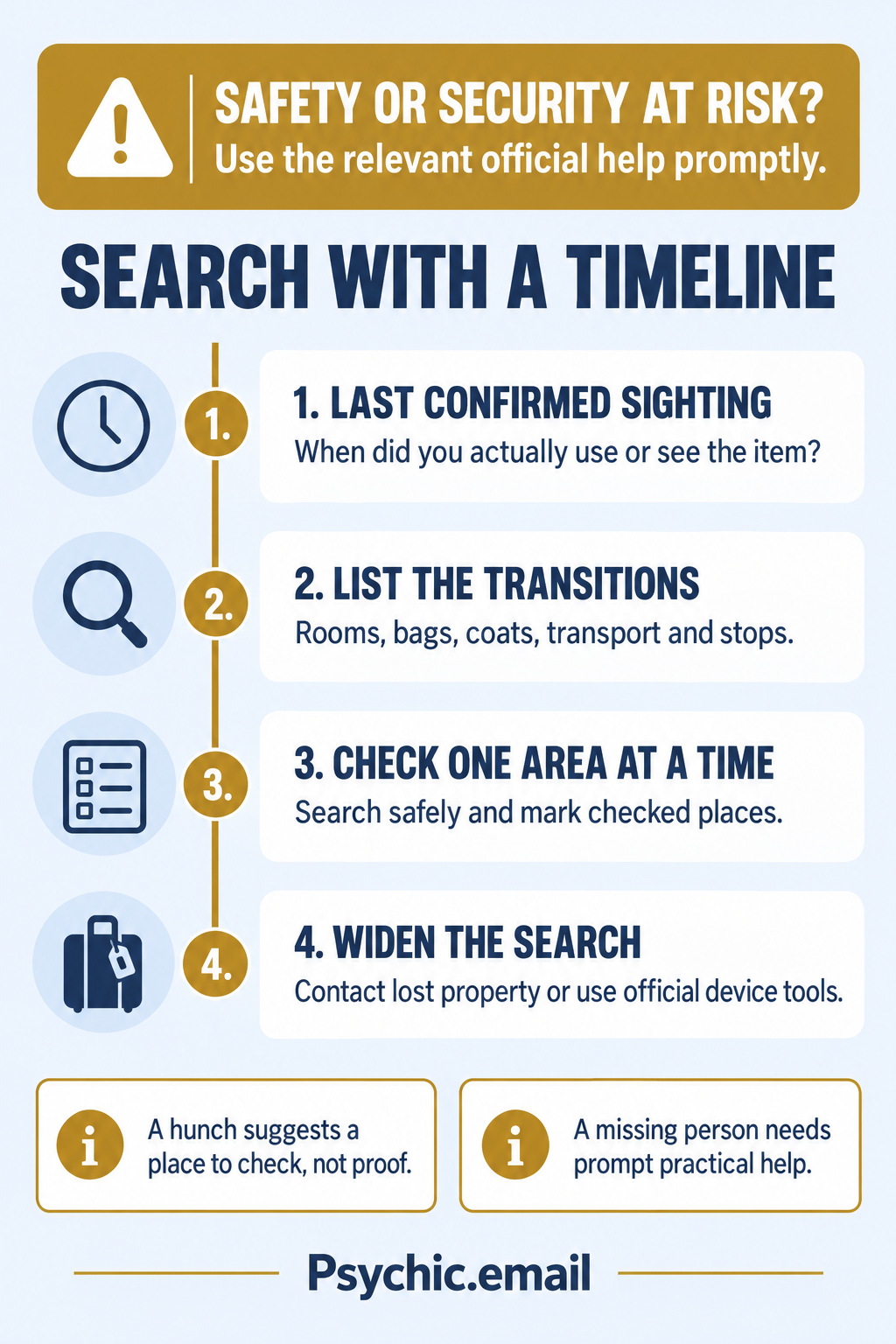
Start from the last confirmed sighting and list the transitions that followed.
3. Check
Search one area at a time and mark it checked before moving on.
An optional pause before you search
- Sit or stand somewhere safe. Leave your eyes open if you prefer.
- Notice the surface beneath your feet and allow your breathing to stay comfortable. There is no need to force a breath or hold it.
- Name the object plainly: “I am looking for the small black key pouch.”
- Ask a factual question: “When did I last actually use it?” Separate a confirmed memory from a guess.
- Choose one next action, then return to the search.
This is not a test of spiritual ability. You do not need special tools, a paid guide or a long session. If being still is unhelpful, skip it and work directly through the checklist.
Build a timeline, not a story
Start with an event you can place: unlocking the door, paying at a shop or taking off a necklace. Then list what changed afterward. Did you swap bags, carry groceries, answer the door or put on a different jacket?
For example, “I used the keys at the front door, put down the shopping and changed coats” gives you three specific areas to inspect. “Someone must have taken them” adds an accusation without locating anything.
- Check pockets, bag compartments and containers individually.
- Look around places where you set things down temporarily.
- Inspect under and beside furniture safely, without moving heavy objects alone.
- Ask other people whether they saw or moved the item, using a neutral description.
- Keep a short checked-area list so you do not restart the same loop.
Use the tools that fit the item
For a device, use the manufacturer’s official recovery guidance. Apple’s lost iPhone and iPad instructions explain Find My and marking a supported device as lost. Features depend on setup and availability. Never give a supposed finder your passcode, password or verification code.
For something left in a public place, contact that location’s lost-property service. Describe the item and the approximate time of your visit. Avoid posting every identifying detail publicly, and do not go alone to confront someone based on a tracker location or a suspicion.
If the loss involves access to your home, important documents or payment details, use the relevant provider’s security process promptly. Searching and protecting yourself can be separate tasks; you do not have to finish one before starting the other.
Keep intuition as a suggestion, not evidence
A sudden thought about the laundry basket is a place to check. It is not proof that the object is there. Record what you actually find rather than rewriting an unsuccessful guess as a hidden message.
Dreams, tarot cards and pendulums do not justify accusing another person. They also should not become a reason to keep paying someone who promises guaranteed recovery. If a reading has made the loss feel frightening or urgent, our guide to responding to anxiety after a psychic reading offers a way to step back.
When this guide is not appropriate
A missing person requires prompt practical help. Do not use this exercise to delay contacting emergency services or local authorities. A missing pet needs an appropriate real-world search and local animal services, not a promise of psychic location.
For ordinary objects, decide when to widen the search, contact a venue or arrange a replacement. Not finding something is not evidence that you failed to meditate correctly.
A simple prevention routine
Choose a visible, consistent home for the items you use daily. Before leaving a room or venue, check the few essentials you brought. Keep serial numbers or purchase details securely where appropriate, without sharing them with strangers. Our privacy guide for email readings explains why a reading request does not need passwords or identity documents.
15 Questions About Finding Lost Items
1. Can meditation tell me where a lost item is?
An image or thought during meditation is not reliable evidence of an object’s location. Treat it as a possible place to check, not as a discovery or a guarantee.
2. What should I do first when I lose something?
Identify the last place you definitely had it, then check the immediate area and the containers you used. If the loss creates a security or safety problem, address that promptly rather than waiting to meditate.
3. How long should the pause last?
Keep it brief if you use it at all. A minute or two is an optional pause before searching, not a special duration that makes an object return.
4. Do I have to close my eyes?
No. You can sit with your eyes open and notice the room around you. Skip the exercise if it makes you uncomfortable.
5. How do I retrace my steps?
List what you did after the last confirmed sighting, including changes of clothes, bags, rooms and transport. Check each transition instead of repeatedly searching the same drawer.
6. What if I remember two possible locations?
Write down both as uncertain possibilities. Search them separately and record what you checked, without treating the more vivid memory as proof.
7. Should I use a pendulum to find keys?
A pendulum’s movement is not dependable location evidence. Search likely places and use practical tools instead of letting a yes-or-no movement rule out an unchecked area.
8. Does finding something after a dream prove the dream located it?
No. A successful guess does not establish a reliable method. You can check a place suggested by a dream while keeping the result separate from a claim of psychic accuracy.
9. Can I use a device tracker?
If the device or item already has a supported tracking service, consult its official instructions. Tracking availability depends on the product and its setup; it is not a promise that every lost item can be located.
10. What should I tell a lost-property desk?
Give the item’s description, the approximate time and place of the loss, and a safe contact method. Keep some identifying details private so you can establish that it belongs to you.
11. Should I post my home address to recover an item?
Avoid publishing your address, account details or identity documents. Use a limited contact method and agree on a safe return arrangement.
12. Should I accuse someone if I feel they took it?
No. A feeling, reading or guess is not evidence of theft. Ask neutral questions about whether anyone moved or saw the item.
13. Can a psychic guarantee recovery?
No psychic reading can guarantee that a missing object will be returned. Do not pay escalating fees for promises to remove a blockage or release an item.
14. What if the missing thing is a person?
A missing person is not a lost-object exercise. Contact the appropriate emergency service or local authorities promptly; do not wait for meditation, a dream or a reading.
15. How can I make future losses easier to manage?
Choose one consistent storage place for everyday essentials, return them there after use, and keep necessary product details securely. A simple routine is more useful than blaming yourself for a mistake.
It is compelling to consider how meditation not only aids in personal well-being but can also be applied to practical situations like finding lost objects. The connection between energy fields and the physical world is well-articulated. The roles of psychic guides and spirit guides also add a spiritual dimension to this practice.
The article provides an interesting perspective on using meditation as a tool for locating lost items. The discussion about different types of bodies and energy fields highlights how interconnected our physical and spiritual selves are. It’s notable how setting intentions and manifesting are emphasized as crucial steps in the process.
The integration of meditation and the search for lost objects is an intriguing concept. It’s fascinating how the process aims to align various energy fields and dimensions to reach a state of unity and clarity. The idea of using psychic tools like pendulums to enhance this practice adds another layer of depth.
Meditation as a means to recover lost objects offers a unique blend of spirituality and practicality. The detailed explanation of aligning different energy fields and dimensions to enhance our intuitive abilities is enlightening. The emphasis on positive intentions and the role of divine guidance is particularly noteworthy.
The article sheds light on an unconventional but thought-provoking method of using meditation to find lost items. The various energy bodies and their roles in this process are well-explained. The combination of meditation, intention setting, and tools like pendulums presents a holistic approach to solving everyday problems.