


Quick Guide
Learn the seven familiar chakra labels as a spiritual reference, not a map of your organs. Use an optional reflection prompt if it is helpful; do not interpret pain, fatigue or low mood as proof of a blocked chakra.
A beginner can easily confuse a colorful chakra diagram with a description of how the body works. The distinction matters: you can explore a spiritual symbol without making it responsible for your health, relationships or ability to think clearly.
What is a chakra?
The word is commonly translated as “wheel” or “circle.” Chakra concepts have roots in Hindu and Buddhist spiritual teachings. The familiar seven-center model is widely used in contemporary lessons, but one chart should not be taken as a complete account of every tradition.
Cleveland Clinic’s introduction to chakras distinguishes the spiritual framework from Western scientific recognition. A label on a diagram is not a medical finding. Associations with body regions and colors below describe the model, not established physical energy centers.
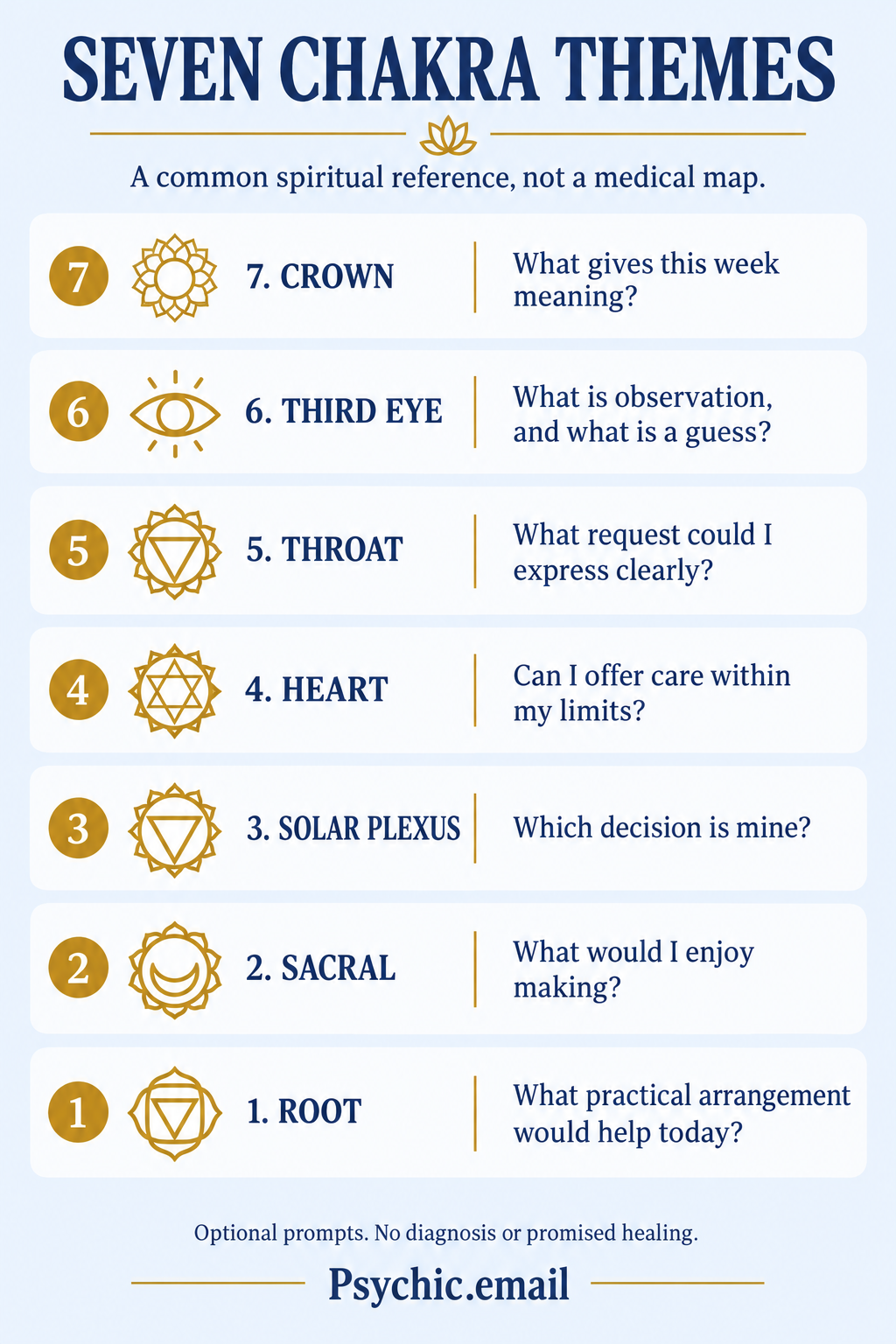
A seven-chakra reference, with original reflection prompts
These are common contemporary labels and color associations. The questions are optional writing prompts, not traditional instructions, tests or a treatment plan. You do not need to agree with the framework to consider a question.
- Root · Muladhara
Base of the spine · red
Reflection: What practical arrangement would make my day less precarious? - Sacral · Svadhisthana
Lower abdomen · orange
Reflection: What would I enjoy making without needing it to be impressive? - Solar plexus · Manipura
Abdominal region · yellow
Reflection: Which decision is mine, and what information do I need? - Heart · Anahata
Center of the chest · green
Reflection: Can I offer care without promising more than I can give? - Throat · Vishuddha
Throat · blue
Reflection: What request could I express more clearly? - Third eye · Ajna
Between the eyebrows · indigo
Reflection: Which part of my impression is an observation, and which part is a guess? - Crown · Sahasrara
Top of the head · violet or white
Reflection: What gives this week meaning without requiring certainty?
Notice what the chart does not tell you: why a symptom has appeared, what another person feels, or which decision guarantees a good outcome. It cannot answer those questions simply by assigning them a color.
Try one prompt, then return to an ordinary action
Choose a question that fits today rather than trying to “fix” all seven centers. Set aside a few quiet minutes if that suits you. Write one concrete observation, one interpretation you are considering and one action within your control.
For example, the throat-themed question might produce: “I agreed to cover another shift, but I need that evening free.” Your next step could be asking to change the arrangement. You do not need to decide whether your throat chakra is open before making that request.
With the root-themed question, the answer might be checking tomorrow’s transport rather than purchasing a grounding object. The heart-themed question might lead to a kind message with a clear limit on what help you can offer. A useful prompt leaves you more specific, not more worried about invisible faults.
What “blocked” should not become
In spiritual conversations, “blocked” may be used loosely for feeling stuck or disconnected. Do not turn it into a diagnosis. Anger does not establish a solar plexus problem, difficulty speaking does not prove a throat blockage, and a headache does not establish a crown blockage.
Physical symptoms and persistent distress deserve appropriate assessment. Keep existing treatment and professional advice separate from an optional spiritual exercise. Our guide to feeling blocked offers a more practical way to distinguish a task problem from a health concern.
Keep the practice voluntary and affordable
No special object, paid scan or repeated appointment is required to learn these labels. If you enjoy a stone or illustration, you can value it as an object without treating it as a cure. Decline claims that only a particular provider can remove a dangerous blockage.
Ask a teacher what their terms mean, what a session includes and whether you can stop. A responsible explanation should leave room for questions and disagreement. Do not share sensitive medical or personal information merely because someone says they need it to read your energy.
When a simpler exercise fits better
If a color visualization feels forced, skip it. You may prefer noticing your surroundings, taking a break or writing a direct question about a current problem. The grounding guide includes a sensory exercise that does not require a belief in energy centers.
For third-eye discussions, the intuition guide explains how to separate a hunch from evidence. Keep a record of what actually happens rather than counting only the impressions that appear to fit.
Frequently Asked Questions
1. What does chakra mean?
Chakra is commonly translated from Sanskrit as wheel or circle. In spiritual teachings, it describes an energy center rather than a structure identified in medical anatomy.
2. Are chakras scientifically established organs?
No. Chakra descriptions belong to spiritual frameworks. They should not be treated as organs, diagnostic findings or an explanation for a physical symptom.
3. What are the seven chakra names?
The common seven-chakra model uses root, sacral, solar plexus, heart, throat, third eye and crown. Sanskrit names are often used alongside these English labels.
4. Does every tradition use the same chakra system?
Do not assume one popular chart represents every teacher or tradition. Ask which framework a lesson uses and how its descriptions are intended to be understood.
5. Which color is associated with the heart chakra?
Green is used in many contemporary seven-chakra charts. Color associations are symbolic conventions, not evidence that an organ emits that color.
6. Does a headache mean my crown chakra is blocked?
No. A chakra chart cannot establish the cause of a headache. Seek medical advice for symptoms rather than using a spiritual label as a diagnosis.
7. Can chakra balancing treat depression?
Chakra balancing is not a substitute for mental-health assessment or treatment. You may choose spiritual reflection alongside appropriate care, but it should not delay that care.
8. Do I need crystals to learn about chakras?
No purchase is required. You can read about the framework or use a simple notebook. An object can be personally meaningful without having a proven healing effect.
9. Does the third eye prove psychic ability?
No. Third-eye language is part of spiritual symbolism. An impression or visualization does not establish access to another person’s thoughts or future events.
10. How can I use a chakra chart for reflection?
Choose one theme, write a question about your own life and identify an ordinary next step. Keep observations separate from interpretations and do not use the chart to diagnose yourself.
11. Do I need to work through all seven in order?
Not for the optional reflection exercise here. You may choose a relevant prompt, skip any uncomfortable topic or decide not to use the framework at all.
12. What if visualization makes me uncomfortable?
Stop or switch to an ordinary activity, such as noticing the room around you. You do not need to force an image or keep going to complete an exercise.
13. Can a reader tell whether my chakras are blocked?
A reader may offer a spiritual interpretation, but that is not a medical test. Ask what they mean and reject pressure to buy repeated services to prevent harm.
14. Can chakra reflection help with communication?
You can use a communication-themed prompt to prepare a clear request or boundary. Any useful change comes from what you practice, not proof that an energy center has opened.
15. What should a beginner avoid?
Avoid symptom diagnosis, guaranteed cures, forced exercises and purchases presented as necessary protection. Keep spiritual choices voluntary and use qualified help for health concerns.
The explanation of how blockages in chakras can impact both mental and physical health is particularly insightful. It makes the concept of chakras more relatable to everyday experiences.
This article provides a clear and concise introduction to chakras. It’s helpful for someone new to the subject and wanting to understand the basics of each chakra and their significance.
I appreciate the breakdown of each chakra and their associated colors and body parts. The information is well-organized and easy to follow for beginners.
The detailed description of each chakra and their functions is quite informative. It would be interesting to see more scientific research on how these energy centers affect our overall well-being.
While the article serves as a good introductory guide, it could benefit from including some practical tips on how to balance or unblock these chakras.
I agree, Lindsay. Adding some meditation techniques or exercises to balance the chakras would make the article even more useful for beginners.