


Quick Guide
Check the service terms, protect private information and watch for pressure. Stop if someone demands extra money to prevent harm, insists on secrecy or claims only they can fix a supposed curse. A photo, friendly manner or high rating does not prove psychic ability.
Scam awareness is about what a provider asks you to do and how they handle money and information. It is not a reliable test of supernatural gifts. Keep those questions separate: a clearly priced service can still make claims that are not established facts.
Warning signs that deserve a pause
The U.S. Postal Inspection Service’s psychic-scam guidance warns about promises involving curse removal, fortune and finding a soulmate. Fear and hopeful promises can be used to draw people into payment demands.
- Threats tied to payment: harm is said to be unavoidable unless you buy protection.
- Escalating charges: the original service becomes a series of urgent additional payments.
- Secrecy: you are told that discussing the situation will ruin the work or bring danger.
- Guaranteed outcomes: certainty about healing, money or another person’s behavior is offered as a reason to pay.
- Account access: passwords, verification codes or identity documents are requested without a legitimate, clearly explained purpose.
- No meaningful choice: questions, disagreement or ending the session are treated as dangerous or disloyal.
You do not need to prove every detail false before declining another charge. A voluntary service should leave you able to say no.
What does not prove trustworthiness
A personal-looking photograph, polished website, familiar country, spiritual vocabulary or enthusiastic profile is not proof of honest conduct. Neither a long list of claimed gifts nor a course certificate establishes predictive accuracy.
A telephone, chat, email or video format is not inherently a sign of fraud. Assess what was promised, what was charged and whether you can contact the business. Do not assume a provider is genuine simply because you can see their face.
Reviews may help you identify recurring complaints about delivery or billing, but adjectives such as “amazing” cannot establish whether a review is genuine. Look for specific details and patterns without treating praise as a guarantee. Our network comparison guide separates practical service checks from claims of accuracy.
Check the terms before you begin
- Identify the business and its contact route.
- Read the full cost, including later rates, renewals or extra questions.
- Confirm the format, duration or question count and expected delivery.
- Read cancellation, refund and complaint terms.
- Set a spending limit and do not increase it during a frightening conversation.
Promotional minutes do not certify a provider. You can decline a service even if a discounted offer is available. If the terms are unclear, ask for clarification before paying rather than trying to discover the rules during the session.
A simple boundary statement
You can say: “I agreed to this reading only. I do not authorize any additional service or charge.” If someone continues making demands, end the conversation. You do not need to argue about a curse or persuade them to accept your beliefs.
Keep personal context brief. The reading privacy guide explains why account credentials, identity documents and other people’s private messages should stay out of a reading request.
If a payment demand feels wrong
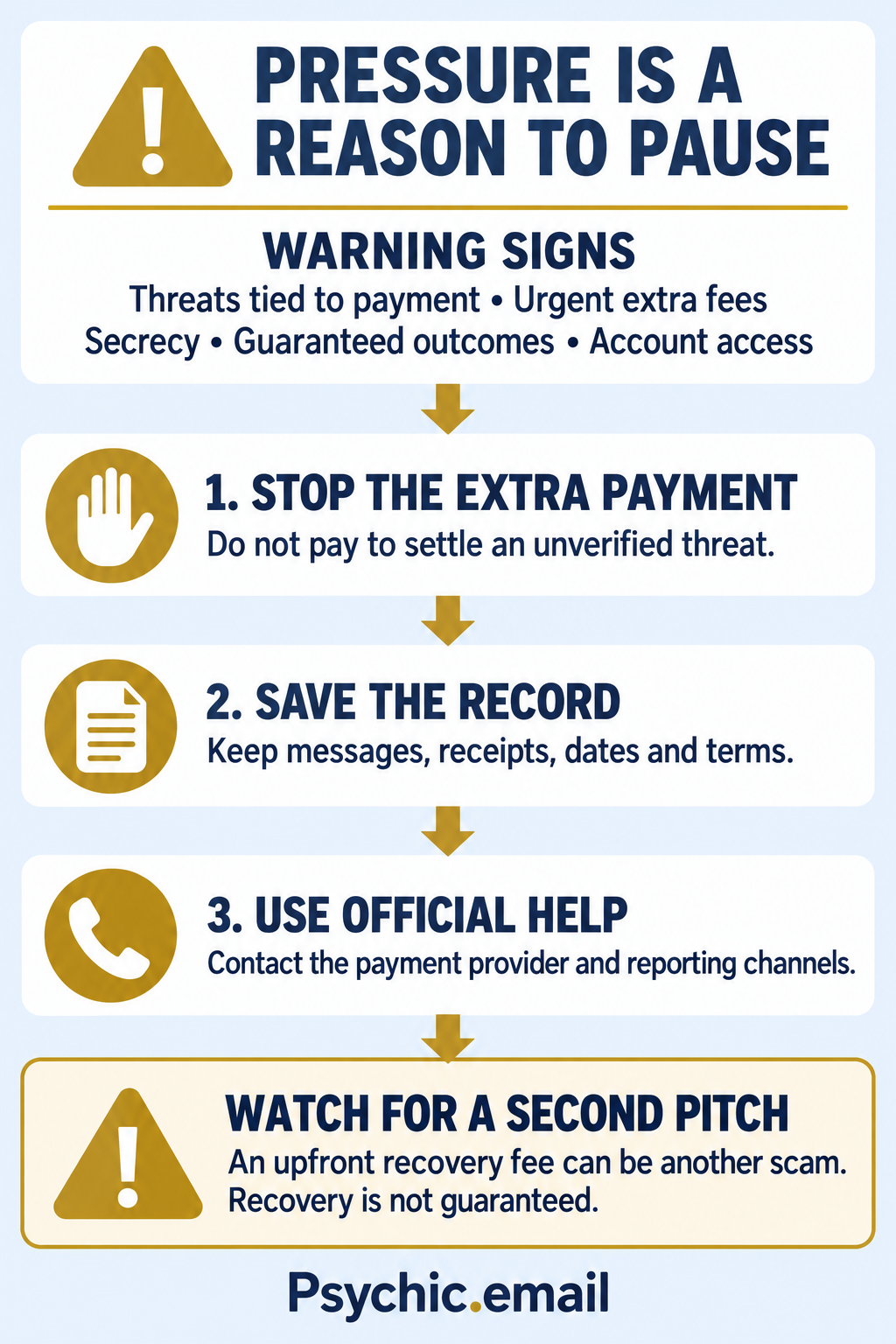
1. Pause
Do not send another payment to settle a threat or finish supposed protection work.
2. Preserve the record
Keep messages, receipts, dates and the terms that were shown.
3. Seek practical help
Use the payment provider’s official contact route and appropriate reporting channels.
If you already paid
The FTC’s steps after a scam explain options for different payment methods and compromised personal information. Contact the relevant payment company or financial institution promptly, describe what happened and ask what can be done. Recovery is not guaranteed.
Keep a clear chronology: the original offer, payments, additional demands and responses. Save evidence before blocking contact where it is safe to do so. Do not send further funds because you are promised the earlier money will be returned after one final fee.
In the United States, you can report suspected fraud through ReportFraud.ftc.gov. Seek local authorities for threats or immediate safety concerns. Outside the United States, use the appropriate local consumer-protection and law-enforcement routes.
Watch for a second “recovery” pitch
The FTC warns about refund and recovery scams: someone may claim they can recover lost money and ask for an upfront fee or financial information. Verify contact details independently, and do not assume an unsolicited helper is legitimate because they know you lost money.
Keep a complaint specific
A reading that feels unhelpful is not automatically proof of deliberate fraud. A useful complaint records what was offered, what happened and what resolution you are requesting. Avoid posting private details or accusations you cannot support.
If worry is pulling you into repeated purchases, the guide to readings when anxious offers a way to pause. You do not need another paid prediction to be allowed to stop.
Frequently Asked Questions
1. Can a checklist prove that a psychic is genuine?
No. You can assess pricing, conduct, privacy and complaint handling, but those checks do not prove psychic ability or predictive accuracy.
2. What is a major warning sign?
A demand for extra money to prevent harm or remove a supposed curse is a serious warning sign. Do not let fear turn an optional service into repeated payments.
3. Does a real profile photo prove honesty?
No. A photograph does not establish identity, business conduct or psychic ability. Check the provider’s actual terms and behavior.
4. Do positive reviews prove accurate predictions?
No. Reviews describe reported experiences and may have limitations. A high rating does not guarantee your experience or establish paranormal accuracy.
5. Is anonymous chat automatically a scam?
No. A format alone does not establish fraud. Look for clear service terms, a usable contact route and behavior that respects your boundaries.
6. Should I pay for curse removal?
Do not pay because someone says harm will occur unless you purchase protection or cleansing. Pause contact and talk with someone you trust rather than negotiating under fear.
7. What if a reader asks me to keep payments secret?
Secrecy around escalating payments or threats is a warning sign. Keep records and seek outside support; you do not have to protect the provider’s claim from scrutiny.
8. What should I check before buying a reading?
Check the full price, duration or question count, delivery format, renewal terms, cancellation or refund policy and the route for raising a complaint.
9. Are free minutes a sign of a trustworthy service?
No. A promotion is not proof of honesty or accuracy. Read eligibility and later charges, and decide whether the service fits your spending limit.
10. Should I give a reader my account password?
No. Do not share passwords, verification codes or account access in a reading. A provider does not need those details to discuss your question.
11. What if I already sent money to a suspected scammer?
Contact the payment company or financial institution promptly, explain what happened and ask what options are available. Preserve records. A refund or recovery is not guaranteed.
12. Can someone guarantee they will recover my money?
Treat unsolicited recovery offers cautiously, especially if they demand an upfront fee or financial details. A recovery promise can be another scam.
13. Is every disappointing reading fraud?
No. A disappointing experience alone does not establish deliberate deception. Report the specific claims, charges and conduct rather than making conclusions you cannot support.
14. Where can I report a suspected scam in the United States?
The FTC’s fraud-reporting service is one reporting route. If there are threats or an immediate safety concern, contact appropriate local authorities; use local consumer-protection routes outside the United States.
15. Do I have to buy another reading to check the first one?
No. You can stop spending and review the actual record. Another paid opinion does not establish whether the earlier claims were true.
The article makes a logical point about the pervasiveness of scams in online psychic services. It’s essential to be cautious when selecting a platform and psychic for a reading.
The suggestion to use chat readings as a way to verify a psychic’s intuition is practical. It allows for a record of the conversation, which can be reviewed later.
I agree. Having a recorded chat can be very useful in assessing the accuracy and reliability of the psychic’s insights.
I appreciate the emphasis on using reputable sites and checking customer reviews. It is a practical approach to filtering out scam services.
Understanding the importance of intuition and recognizing different methods used by psychics can indeed provide a more informed decision-making process for selecting a genuine psychic.
The tips for spotting fake psychics, such as evaluating their profiles and looking for inconsistencies, are insightful and can help avoid falling victim to scams.