


Quick Guide
A remote psychic reading is delivered without meeting in person, commonly by email, phone, live chat or video. The format can change convenience, privacy and how you communicate. It does not establish predictive accuracy, complete anonymity or freedom from bias.
Remote access may save travel, but “online” is not one uniform service. A written reply with a delivery window is different from a conversation billed by the minute. Choose by the actual arrangement rather than a promise that distance makes a reading more powerful.
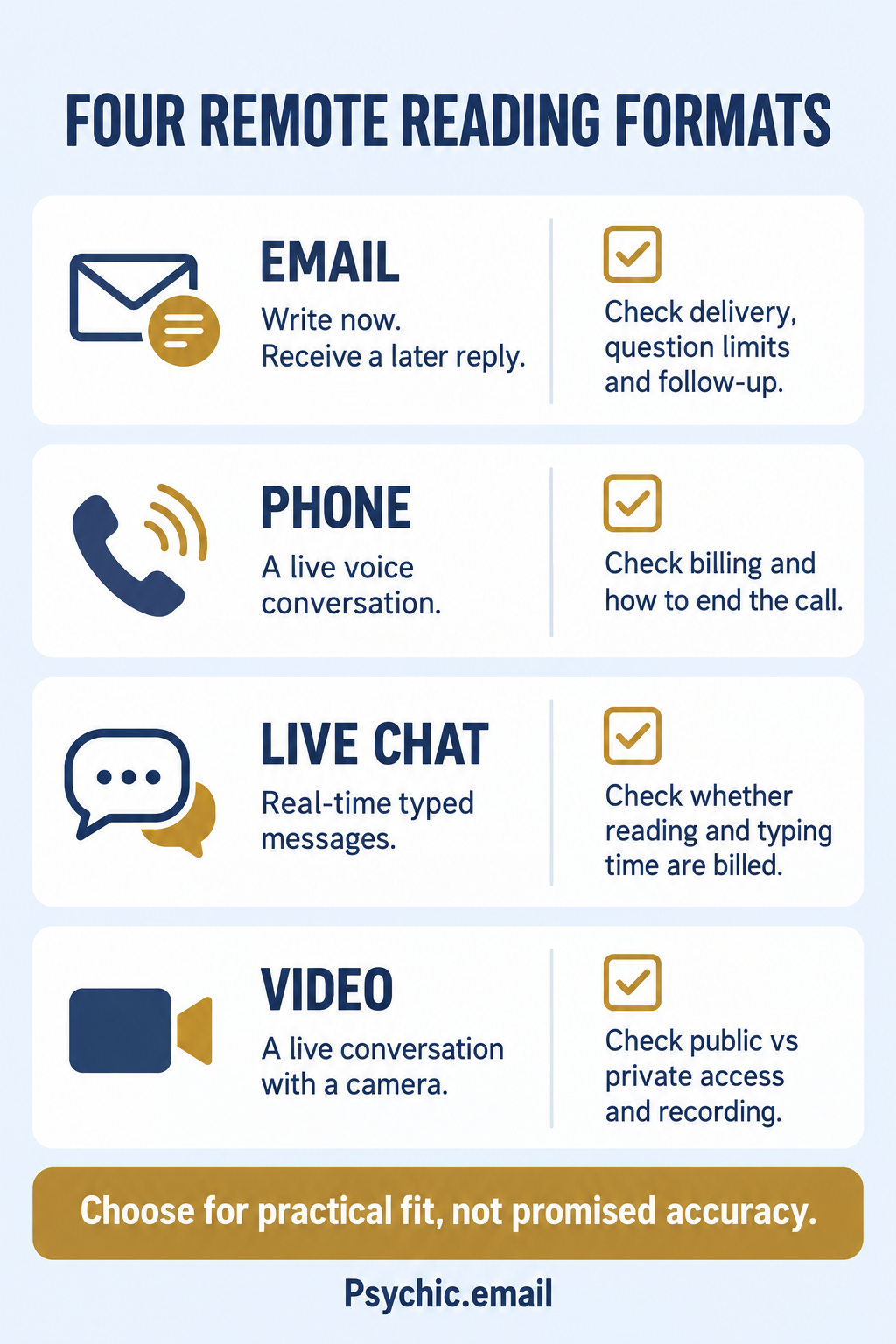
Compare the four common formats
Email: a request and written reply
Email can suit someone who wants to compose a question and revisit the response. Confirm what counts as a question, when the reply is expected and whether follow-up clarification is included. A message you can reread is not necessarily more accurate.
Also consider where the email is stored, who has access to the inbox and what appears in notifications. Review the email-reading privacy guide before sharing context.
Phone: a live voice conversation
A call allows spoken questions and clarification during the session. Check the charging basis, any minimum duration and the way to end the call. Headphones may reduce what people nearby hear, but they do not make the service anonymous or confidential by themselves.
A voice still gives information about a person, and whatever you share can influence the exchange. Do not assume that the absence of a camera eliminates bias.
Live chat: real-time typed messages
Chat can be useful when you prefer typing or cannot talk aloud. It may require prompt replies, so consider your comfort with typing speed and any accessibility needs. Check whether billing continues while you read or type and whether a transcript is available.
Do not assume a transcript exists, that it will remain accessible or that the provider deletes it afterward. Read the applicable terms.
Video: a live conversation with a camera
Video adds visual interaction and may also reveal your surroundings. Review what is visible, whether the camera is required and how the service handles recordings. You may prefer another format rather than show your home.
A face-to-face appearance on screen does not turn an interpretation into verified information.
Three separate questions
Access
Can you comfortably use the format, schedule and connection?
Privacy
What will you share, who can see or hear it, and what records remain?
Evidence
What is an interpretation, and what can be independently checked?
Remote does not mean anonymous
A provider may ask for contact, account or payment details. The amount depends on the service; check its actual privacy policy rather than assuming every platform collects the same information.
You can limit optional context, but do not send false payment information or another person’s identifying details. Leave out account passwords, verification codes and sensitive documents not necessary for the service.
Protect the email or provider accounts you actually use. CISA’s account-security guidance recommends strong passwords and multifactor authentication where offered. Those precautions reduce account risk; they do not verify a reader’s claims.
Choose a setting that works safely
Use a space where you can attend to the exchange without unwanted interruptions. A home is not automatically private, and a public space may expose your conversation or screen. Consider shared devices, notifications and other people nearby.
Do not take a reading while driving. NHTSA explains that phone conversations and other activities can distract from driving. If a car is your chosen private space, be safely parked before starting.
For live sessions, check the device, audio or text interface beforehand. Ask what happens if the connection drops instead of assuming an automatic refund or free restart.
Check the service, not just the profile
- Format: does the specific reader offer the service you want?
- Scope: how many questions, how much time or what written reply is included?
- Cost: what is the charging basis and what extras are optional?
- Delivery: scheduled appointment or stated written-response window?
- Records and support: what terms apply to recordings, transcripts, clarification and problems?
The reader listings are a starting point, not a substitute for those checks. Use the preparation brief to write a manageable request.
Keep decisions and boundaries with you
You can question a statement, decline a topic or stop. Neither a remote format nor an in-person meeting establishes that a reader can access another person’s private thoughts, diagnose illness or guarantee an outcome.
For relationship topics, use questions about your own choices. If the exchange becomes alarming or pushes urgent paid extras, pause and review the scam warning signs.
The useful comparison is practical: which communication method fits your needs, terms and privacy limits? No format needs to be labeled the “most effective” to make that decision.
Frequently Asked Questions
1. What is a remote psychic reading?
It is a reading delivered without meeting in person, such as by email, phone, live chat or video. The format describes communication, not verified predictive ability.
2. Are remote readings as accurate as in-person readings?
A delivery format does not establish accuracy. Do not assume either remote or in-person readings provide verified predictions.
3. Is a phone reading the most effective format?
This article does not establish a most effective format. Choose by communication preferences, practical terms and privacy needs rather than an accuracy promise.
4. What is the main practical difference with email?
You send a written request and receive a written reply under the provider’s terms. Confirm the question limit, delivery window and clarification arrangements.
5. How is live chat different from email?
Live chat is a real-time typed exchange, while email is generally a request and later reply. Confirm how chat time is billed and whether a transcript is available.
6. Do remote readings make me anonymous?
Not necessarily. Providers may require contact, account or payment details. Read the specific service’s privacy policy and limit optional context.
7. Does turning off the camera remove bias?
No. A reader may still receive information through your voice, words and context. The absence of visual cues does not establish freedom from bias.
8. Should I use video from my home?
Consider what the camera reveals and whether others can hear the session. Check whether video is required and choose another format if it better fits your privacy needs.
9. Can I have a reading while driving?
No. Do not combine a reading with driving. If using a car as a private space, be safely parked before beginning.
10. Are headphones enough for privacy?
No. They may reduce what others hear, but shared devices, notifications, your spoken replies and provider records can still affect privacy.
11. What happens if the connection drops?
The provider’s terms determine the response. Ask about dropped connections, billing and support before booking rather than assuming a free restart or refund.
12. Can I record a remote session?
Check the service’s rules and applicable requirements before recording. Do not assume recording is allowed or that a provider-created recording will be available.
13. Do all listed readers offer email?
No. Check the specific reader’s available formats. A call or chat listing does not necessarily include a written email service.
14. What account-security precautions help?
Use strong passwords and multifactor authentication where offered for the accounts you use. Do not share passwords or verification codes with a reader.
15. Can I stop a remote reading?
You can pause or end an exchange and decline unwanted topics. Check practical billing terms, but do not treat payment as permission for pressure or unlimited disclosure.
The emphasis on convenience and accessibility in phone readings is noteworthy. Removing the need for travel and allowing readings to happen anywhere certainly broadens the potential client base and could make the experience more comfortable for many.
The article makes a strong case for the viability of remote psychic readings. Highlighting freedom from geographical constraints and the potential for increased focus by the psychic are particularly persuasive arguments.
The arguments presented for remote readings are quite compelling. The aspects of anonymity and reduced distractions are particularly significant. It’s interesting to consider how these factors might actually enhance the accuracy and effectiveness of a psychic reading.
While the benefits of remote psychic readings are well-articulated, it would be interesting to see some empirical evidence or studies comparing the accuracy of remote versus in-person readings. Personal anecdotes and professional opinions certainly add value, but data would be compelling.
I appreciate the breakdown of the benefits associated with remote psychic readings. The idea that a psychic can maintain objectivity more easily without seeing the client’s emotions is a valid point that hadn’t occurred to me before.