

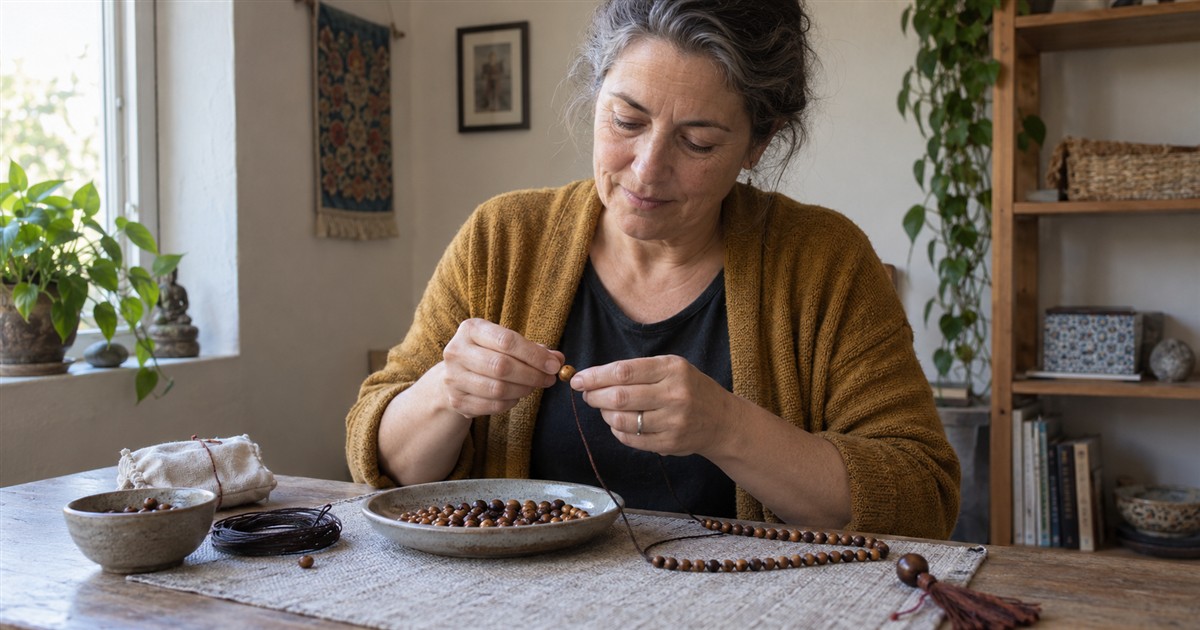
Quick Guide
For this simplified adult craft project, prepare 108 counting beads and one larger marker. Test the cord and bead holes before stringing, leave enough length for knots and inspect the finished loop. The beads are a counting tool, not guaranteed protection or healing.
A handmade strand can give you a tactile way to keep count. The construction matters: a beautiful bead is not useful if its hole cuts the cord or the finishing knot slips. This guide is a simple craft adaptation, not an authoritative ritual for every tradition.
Respect the purpose and the differences
Malas are used in Hindu and Buddhist practice, with variations in design and handling. Sakura Designs’ explanation of its malas describes a common 108-bead form and a larger guru bead. A maker’s design is an example, not a universal rule for every community.
If you follow a particular religious practice, ask a knowledgeable teacher about its conventions. Do not assume a mala is interchangeable with every other prayer-bead tradition or present a decorative craft as conferring spiritual status.
Materials for the simplified project
- 108 smooth counting beads with consistent holes.
- One larger, single-hole marker bead that can accommodate both cord ends.
- Suitable beading cord, with generous extra length for knots and finishing.
- A tray or beading board and a temporary bead stopper or clip.
- Scissors, and a beading needle if compatible with the holes.
- An optional ready-made tassel with an attachment loop.
A three-hole guru bead needs different threading instructions. Do not substitute one without understanding its route. This version uses a single-hole marker to keep the construction simpler.
Choose beads by comfort, weight and hole quality. Wood or inexpensive smooth beads may suit you better than a heavy stone strand. No material is required to make the tool “work with your energy.”
Before you cut: test five beads
Thread a short sample and tie the knots you plan to use. Check that the cord passes through smoothly, the knots stay outside the holes and the beads are not held so tightly that the strand becomes rigid.
Measure that sample to estimate the full run, then add generous extra cord for the marker, finishing and adjustments. Exact length depends on the materials; avoid cutting to a universal measurement before testing.
For a rough check, 108 beads measuring 8 mm along the hole axis occupy about 864 mm before knots. Knot spacing and the finish add length. Your actual beads may differ, so use the sample rather than the rough calculation to plan.
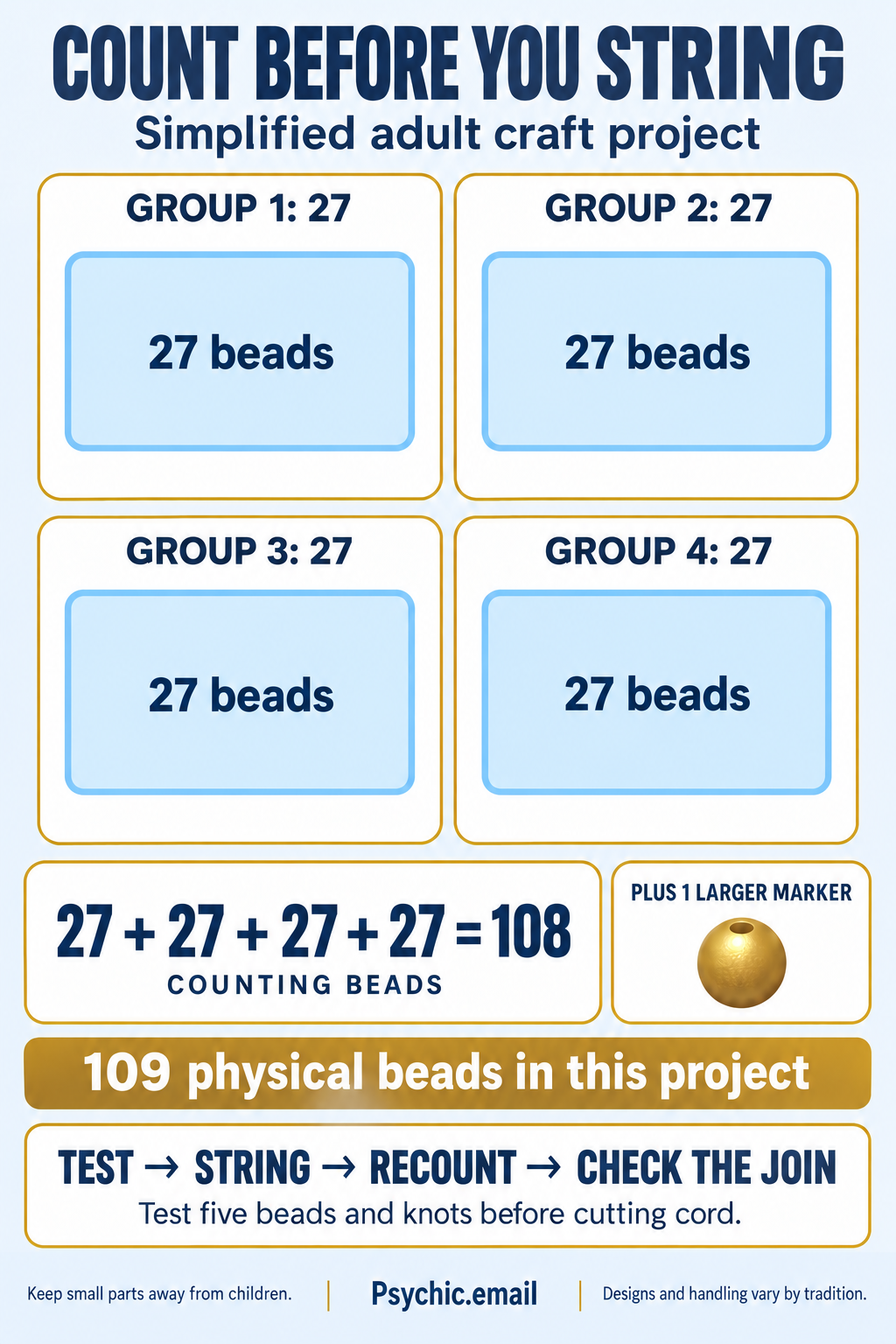
Count before stringing
Lay out four groups of 27 counting beads. That gives 27 + 27 + 27 + 27 = 108. Set the larger marker aside; it is additional, not a replacement for a counting bead in this project.
- 108 counting beads form the repeating run.
- One larger marker identifies the join.
- 109 physical beads are used altogether in this simplified assembly.
Assembly, step by step
- Secure a working tail. Add a temporary stopper, leaving a generous tail for finishing.
- String and separate. Add one counting bead, then form an overhand knot close to it. Repeat, using the knot size tested in your sample.
- Check in groups. Pause after each group of 27 and recount. Do not wait until the final knot to find a missing bead.
- Check the run. Confirm 108 counting beads and inspect for fraying, sharp holes or overly tight sections.
- Add the marker. Remove the temporary stopper. Bring the two ends together and pass them through the larger marker’s single hole. If they do not fit, change the component rather than forcing the cord.
- Finish the join. Tie the ends together below the marker using a secure finish suitable for your cord. Leave working tails while checking the join; attach an optional tassel by its loop if you wish.
- Test gently. Check that the finish does not slip and the marker cannot slide over it. Follow your cord supplier’s finishing instructions before trimming. If unsure, ask a beading specialist to inspect it.
Use the finished strand in your hands first. If you want it as a necklace, check fit and construction separately. Do not wear a cord loop while sleeping or during activities where it could catch. This project is not a children’s toy.
Use and care
For a simple counting exercise, move one counting bead at a time through your fingers while repeating a phrase you choose. The marker identifies the end of the run. Religious recitation and handling rules depend on the practice you follow; this is not a universal instruction.
You can stop before completing a round. The meditation guide explains why a voluntary exercise does not require forced calm or a fixed duration.
Inspect the cord regularly. Store the strand dry and follow material-specific cleaning instructions. Do not soak unknown wood, dyed beads or cord. A broken strand needs a construction check, not an interpretation about negative energy.
Keep small parts out of reach
The CPSC’s toy-safety guidance warns about small parts around young children. Keep the loose beads and tools in a secure adult workspace and gather spills immediately.
No purchase or handmade object is necessary for spiritual reflection. If someone uses a damaged bead or broken cord to pressure you into protection payments, the scam-awareness guide explains why to pause.
Frequently Asked Questions
1. What is a mala?
A mala is a string of beads used in some Hindu and Buddhist practices to count repetitions or support attention. Designs and methods differ across traditions.
2. How many beads does this project use?
This simplified project uses 108 counting beads plus one larger marker bead. The marker is additional, making 109 beads in the physical assembly.
3. Is every mala exactly the same?
No. Bead counts, markers, materials and handling conventions vary. Ask a teacher about the practice you follow rather than treating this craft adaptation as universal.
4. Does the marker count as one of the 108?
Not in this project. Count the 108 smaller beads separately before adding the larger marker.
5. Do I need expensive gemstones?
No. Choose suitable beads for comfort, weight and construction. A high price or a stone’s name does not establish protection or healing.
6. What should I test before stringing all the beads?
Test that your cord passes through the bead holes, that your knots do not slide through and that both cord ends fit the larger marker’s hole.
7. How much cord do I need?
The amount depends on bead size, knots and finishing. Test a short sample, estimate the finished run and leave generous extra length before cutting.
8. Must I put a knot between every bead?
Not for every design, but this project uses knots to separate the counting beads. The knot must fit the cord and remain larger than the bead hole.
9. Can I use a three-hole guru bead instead?
That is a different finishing arrangement. Follow instructions for that specific component rather than forcing the single-hole method shown here.
10. Can I make a wrist version with these instructions?
Do not assume a full-length loop will fit a wrist. A wrist design needs its own count, fit and closure checks; this tutorial is for a full counting strand.
11. Is a homemade bead strand safe for a child?
This is an adult craft project, not a children’s toy. Keep loose beads, cords, needles and scissors away from young children.
12. Should I wear the loop around my neck?
Use it in your hands first. If you intend to wear it, check fit and secure construction; do not wear a cord loop while sleeping or where it could catch.
13. Do mala beads guarantee calm or protection?
No. They may serve as a counting tool or hold personal meaning, but they do not establish a guaranteed emotional or protective effect.
14. How should I care for the finished strand?
Inspect the cord and knots, store it dry and use cleaning guidance appropriate to the actual materials. Do not soak unknown beads or cord.
15. What if the strand breaks?
Gather loose pieces safely and inspect the materials before restringing. A broken cord is a construction issue, not proof of bad energy or a spiritual warning.
It’s fascinating how the mala necklace has such deep spiritual significance and serves as a tool for meditation. The detailed explanation of the materials and their symbolic meanings adds a lot to understanding its importance.
Creating your own mala necklace seems like a meaningful and personalized way to embark on or enhance a spiritual journey. The step-by-step guide is very helpful for beginners.
The comparison between the mala necklace and the Rosary is quite apt. Both serve as counting tools to aid in meditation and prayer.
Yes, I agree. It’s interesting how different cultures have similar practices when it comes to spiritual tools.
Indeed, the cross-cultural similarities in using beads for meditation and prayer highlight how universally significant these practices are.
I appreciate the detailed instructions on how to take care of the mala necklace. It makes sense to treat something with such spiritual energy with care and respect.
The use of various natural materials like jade, rose quartz, and bodhi seeds in the mala beads is intriguing. Each material likely carries its own unique energy and significance.