


A useful dream-reading email separates what you remember from what you want to explore. A detailed message can help a reader understand your question, but it does not turn their interpretation into a verified explanation. You can use the same writing exercise privately without buying a reading.
Decide what kind of response would help
Choose a purpose before composing the message. Perhaps you want alternative associations for an image, questions for a journal, or help expressing why a scene stayed with you. A request such as “What questions could I explore about this feeling?” leaves room for your own judgment.
Avoid treating the email as a way to establish whether a partner is unfaithful, a relative is hiding something or a future event is certain. The content of a dream cannot supply those facts, and a written reading cannot verify them on another person’s behalf.
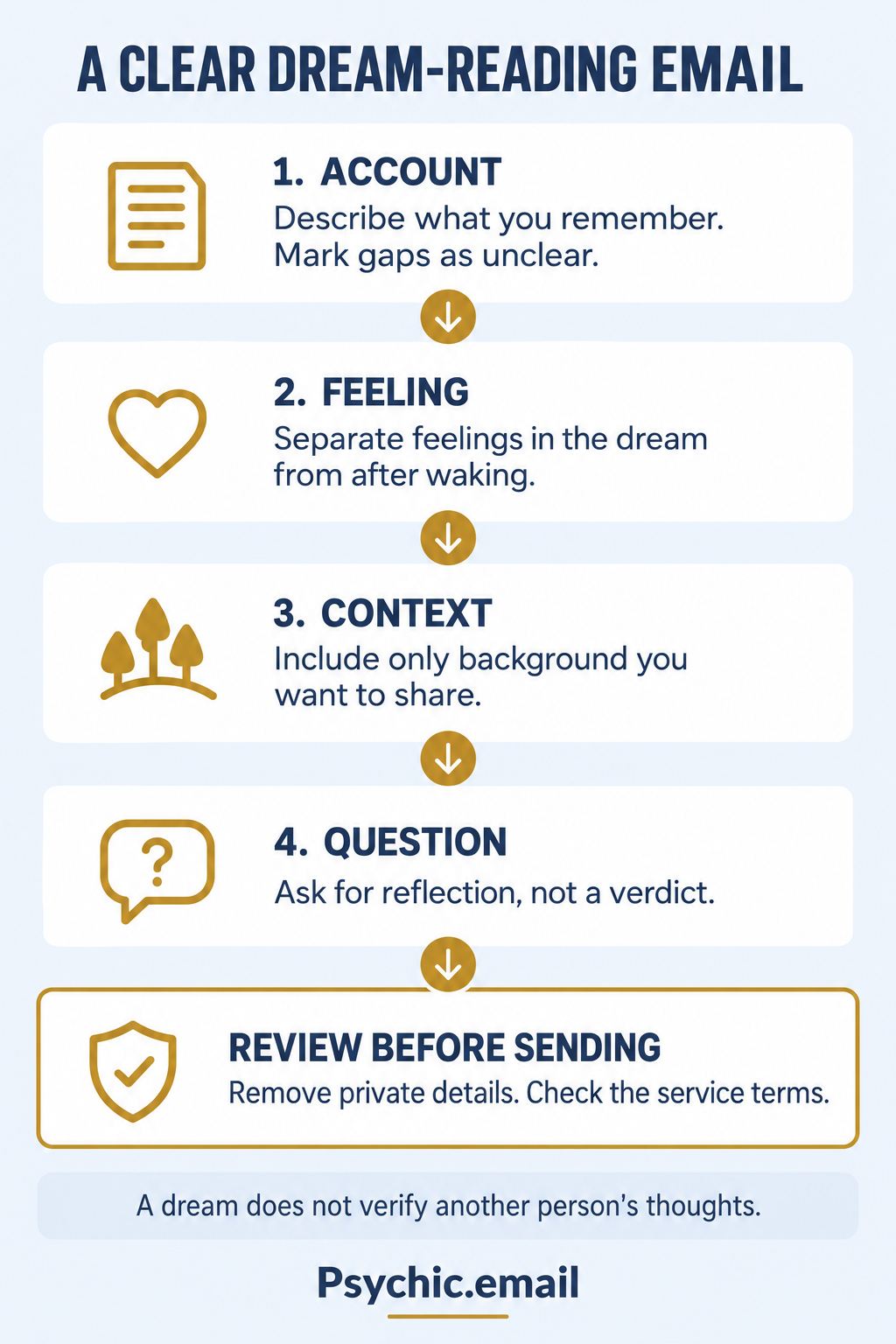
Build the message in four short parts
- The account: Describe the scene as you remember it. Mark gaps with “unclear” rather than filling them in.
- The feeling: Distinguish how you felt during the dream from how you felt after waking.
- Relevant context: Include only the ordinary background you are comfortable sharing, such as preparing for a move.
- Your question: Ask for a reflection prompt or possible association, rather than an authoritative verdict.
A fictional four-part email brief
“I dreamed I was packing a suitcase but could not find the handle. I remember feeling frustrated. I am considering a move, although I have not decided. What questions might help me explore that association?”
This invented example shows the structure; it does not assign a meaning to every suitcase dream.
Keep private information out of the draft
You usually do not need another person’s surname, workplace, private messages or medical history to describe a dream. Use a relationship description such as “a friend” where that is sufficient. Keep your original journal entry and make a separate, shorter version for sharing.
Before sending it, check the provider’s privacy terms, price, delivery time and whether a follow-up question costs extra. Keep a copy of what you submitted so you can compare the reply with the information the reader actually received.
Read the reply in two passes
First identify what the reader is reflecting back from your own account. Then identify what they have added. Label those additions as suggestions, and ask yourself whether they fit your experience or simply sound broad enough to fit many situations.
You can reject an interpretation politely or leave it undecided. A confident tone, lengthy reply or accurate repetition of your details is not independent evidence of hidden knowledge. Do not accept pressure to purchase repeated sessions to remove a supposed dream-related curse.
Keep the science and the interpretation separate
Our guide to dream facts and common myths distinguishes sleep research from claims about symbols and predictions. It can help you frame a question before consulting a reader.
If recurrent nightmares interfere with everyday life or sleep, consider medical support; the NHS advises a GP review for that situation. An email interpretation is not a clinical assessment.
A final send-or-wait check
- Have I marked uncertain memories rather than filling gaps?
- Does the message contain only context I am comfortable sharing?
- Is the question about reflection rather than verifying private facts?
- Do I understand the service terms and the full cost?
- Would private journaling or appropriate professional support fit better?
For optional symbol prompts, see body, car and bathroom images. If an image suggests an idea, use dream-inspired problem-solving to check it while awake. Neither exercise requires buying a reading.
Frequently asked questions
1. What makes a useful dream-reading email?
Separate the remembered scene, feelings, relevant context and a focused question. Clear writing helps explain the request but does not verify the interpretation.
2. Do I need to buy a reading to use the exercise?
No. You can write the same brief privately for reflection or decide not to interpret the dream.
3. What kind of question should I ask?
Ask for possible associations or questions to explore, rather than a verdict about hidden facts, another person or a certain future event.
4. Should I include every detail from my journal?
No. Keep the original private and prepare a shorter account with relevant details you are comfortable sharing.
5. What if a part of the dream is unclear?
Mark it as uncertain rather than inventing a detail. A partial account is more honest than filling gaps to complete a story.
6. Should I separate dream feelings from waking feelings?
Yes. How you felt in the scene and how you felt after waking may differ; recording both avoids merging them into one account.
7. How much everyday context is useful?
Include only relevant background, such as considering a move, that you are comfortable disclosing. You do not need to provide private documents or another person’s history.
8. Can I use “a friend” instead of a full name?
Yes, when that is enough to explain the scene. Minimize identifying information about other people.
9. Can a dream email establish whether someone cheated?
No. A dream or interpretation does not verify another person’s private actions. Avoid using it as evidence for an accusation.
10. What service terms should I check?
Check price, expected delivery, privacy information and whether follow-up questions cost extra. Make sure you understand what you will receive before sending.
11. Why should I keep the submitted message?
It lets you compare the reply with the details the reader already received, separating repetition from new suggestions.
12. How should I read the response?
First identify what reflects your account, then identify additions. Treat those as suggestions and consider whether they fit or are broad enough to fit many situations.
13. Does a long or confident reply prove hidden knowledge?
No. Length, certainty or accurate repetition of details you supplied is not independent evidence of paranormal access.
14. Can I reject the interpretation?
Yes. You can disagree, leave it undecided or stop. You do not need another purchase to make the dream meaningful or remove a claimed curse.
15. When should nightmares prompt healthcare support?
Seek appropriate medical support when regular nightmares affect sleep and everyday life. An email interpretation is not a clinical assessment.
I find the suggestion to use one’s own associations rather than relying heavily on dream dictionaries to be quite practical. Individual symbolism can vary greatly, and personal experiences undoubtedly shape how we interpret our dreams.
The notion that dreams can be a source of knowledge and self-discovery is very appealing. However, I wonder how much of this is supported by empirical research. It would be beneficial to explore more scientific studies on the psychological impact of dreams.
The concept of dreams having multiple levels of meaning is compelling. From a neurological perspective, it’s intriguing to consider how different layers of our consciousness could be communicating through dreams. However, one must consider the limitations of interpreting these signals.
The article does a good job of highlighting that dream interpretation is a deeply personal endeavor. I appreciate the suggestion to use a dream journal, as it can help track patterns and recurring themes that may reveal underlying issues.
The idea that dreams can offer a window into our subconscious and even influence our mood throughout the day is quite fascinating. This aligns well with Jungian theories of the unconscious. However, it’s important to approach dream interpretation with a level of caution and skepticism.
Indeed, Chief. While dream interpretation can offer insights, it is essential to ensure that we do not over-interpret or give undue weight to dreams without considering other psychological factors.