

Quick Guide
Clairvoyance refers to a claimed ability to obtain information through “clear seeing” beyond ordinary perception. It is not established by vivid dreams, strong imagination, tingling or seeing a Magic Eye image. Keep spiritual interpretations separate from visual experiences that may need eye care or medical support.
You may use imagery for reflection or hear a reader describe an impression as clairvoyant. The important distinction is between what was experienced, what meaning was added and what can actually be verified.
Clairvoyance is a claim, not a visual-skills score
The APA Dictionary includes clairvoyance within alleged extrasensory perception. Enjoying art, remembering faces or visualizing a scene does not by itself demonstrate access to hidden facts or future events.
The glossary of the clairs explains related terms. Those labels describe interpretations used by practitioners, not a diagnostic checklist of abilities.
Magic Eye pictures do not require psychic portals
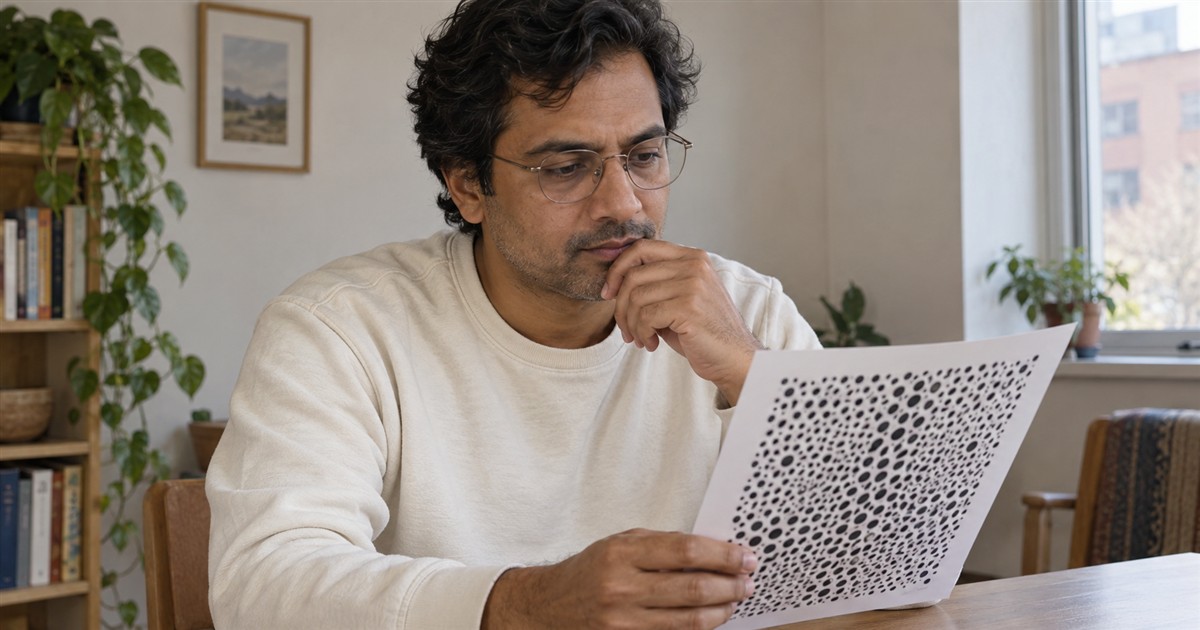
Magic Eye images are autostereograms: patterned images designed to produce an impression of depth. The creator’s FAQ explains their visual design and the role of depth perception. Seeing the hidden shape involves visual processing, not proof of extrasensory perception.
Difficulty seeing a stereogram does not mean your psychic ability is blocked. It also should not become a reason to force your eyes through discomfort or buy an activation service.
Three different experiences
Imagined scene
A picture in your mind can be a memory, creative image or reflection.
Designed illusion
A stereogram uses visual information already present in the image.
Visual change
New flashes, floaters or a shadow may need prompt eye care—not a spiritual explanation.
Why “signs” do not prove clairvoyance
A vivid dream can be emotionally meaningful without predicting an event. A strong visual impression does not establish another person’s intentions. Nor does an unexplained sensation prove that a third-eye chakra opened.
Do not combine ordinary experiences into a score that labels you gifted or blocked. If you want to explore the symbolism, the chakra guide keeps those themes separate from medical anatomy and diagnosis.
Do not train through blurred vision
You do not need to follow a swinging pendulum until your eyes blur, stare at water until something appears or become unusually tired to explore an image. Discomfort is a reason to stop, not confirmation that a portal is opening.
Use an ordinary comfortable focus, or choose a nonvisual activity. A symbol does not need to look vivid to provide a question for reflection.
An optional image-reflection exercise
This original exercise is not a clairvoyance test. It stays with your own thoughts and choices.
- Choose a familiar neutral image: a path, a room or an everyday object. You can use words instead of visualizing.
- Describe it: write what came to mind without claiming it is a hidden fact.
- Name an association: “A path reminds me of a decision I am considering.”
- Ask a practical question: “What information do I need before choosing?”
- Check separately: get relevant facts through ordinary appropriate sources before acting.
A meaningful association remains an association. For reviewing impressions over time, see the intuition-log guide, including misses and uncertain outcomes.
When a visual change needs attention
The National Eye Institute identifies a sudden increase in floaters, flashes and a curtain-like shadow as possible retinal-detachment symptoms. It advises seeing an eye doctor or emergency department right away when these symptoms occur.
Do not interpret those symptoms as clairvoyant signs or delay help for a reading. This article cannot diagnose what is causing a visual experience.
If you see things that seem real but are not present, or have other unusual sensory experiences, seek medical advice. NHS guidance on hallucinations explains that they can have different causes and deserve appropriate help.
Sharing an image is not sharing a fact
Ask before sharing a spiritual interpretation about someone. Do not present an image as proof of cheating, illness, a child’s needs or a future loss. The reading-consent guide covers those limits.
You can be curious about clairvoyance without claiming certainty. Preserve privacy, check consequential details and use practical care when needed. A responsible boundary matters more than how vivid an impression feels.
Frequently Asked Questions
1. What does clairvoyance mean?
It refers to a claimed form of clear seeing beyond ordinary perception. The label does not establish that a visual impression reveals hidden facts or future events.
2. Does seeing a Magic Eye image prove clairvoyance?
No. Magic Eye images are designed autostereograms involving visual information and depth perception, not proof of extrasensory perception.
3. Does difficulty seeing a stereogram mean I am blocked?
No. It does not establish a spiritual blockage or a need to buy psychic activation.
4. Are vivid dreams evidence of a psychic gift?
Not by themselves. A dream can be meaningful without demonstrating a prediction or access to hidden information.
5. Does tingling prove that my third eye opened?
No. A sensation does not establish a chakra event or paranormal ability. Seek appropriate care for concerning symptoms rather than diagnosing them spiritually.
6. Should I stare at a pendulum until my vision blurs?
No. You do not need blurred vision or fatigue to explore imagery. Stop if an activity causes discomfort and choose an ordinary comfortable focus or another activity.
7. Can I reflect without visualizing clearly?
Yes. You can write words or use a familiar neutral image. Vivid imagery is not required for reflection.
8. What is the purpose of the five-step exercise?
It turns an ordinary image into a question about your own choices, then separates that association from facts that need checking. It is not a clairvoyance test.
9. How should I describe a mental image?
State that you pictured it and label any meaning as an association or interpretation. Do not present it as something that happened without verification.
10. Can a strong image reveal someone’s intentions?
A strong impression does not give verified access to another person’s private thoughts. Use appropriate direct communication and ordinary evidence.
11. What if I suddenly see more floaters or flashes?
Get prompt eye care. The National Eye Institute identifies sudden increased floaters, flashes or a curtain-like shadow as possible retinal-detachment symptoms requiring an eye doctor or emergency department right away.
12. Should I wait for a reading about a shadow over my vision?
No. A new curtain-like shadow can need immediate eye-care attention. Do not delay practical medical help for a spiritual interpretation.
13. What if I see things that seem real but are not present?
Seek medical advice rather than assuming clairvoyance. Unusual sensory experiences can have different causes and cannot be diagnosed by this article.
14. Can I share a vision about another person?
Ask for consent before offering a spiritual interpretation. Do not use it to accuse, diagnose, alarm or claim knowledge of private matters.
15. Can I explore clairvoyance while keeping clear limits?
Yes. Learn the terms and reflect on imagery without claiming certainty. Protect privacy, check consequential facts and use appropriate care when needed.
While I am skeptical about the practical application of clairvoyance, the idea of enhancing perception through mental exercises is certainly interesting. The approach described could simply be a way to improve focus and mindfulness.
I remember 3D magic eye pictures from the 90s. It’s an interesting analogy to use for explaining clairvoyance. However, more scientific validation would be helpful in understanding how extrasensory perception works.
You make a good point. While the article is engaging, it would benefit from more empirical evidence. Nonetheless, it’s intriguing to consider the potential of our minds.
The descriptions of clairvoyant experiences are detailed and quite vivid. It makes me wonder how many people genuinely experience these phenomena.
Indeed, Tiny. Personal anecdotes are compelling, but it would be useful to see statistics or studies on how widespread these experiences might be.
The techniques mentioned, such as using a pendulum, seem reminiscent of traditional practices in various cultures. It’s intriguing to see these methods discussed in a modern context.
The concept of clairvoyance and extrasensory perception is fascinating, albeit controversial. I appreciate the explanation about how one can potentially harness these abilities through various exercises.