

Quick Guide
Meditation, stones, pendulums, scented oils, incense and candles are optional practice choices—not guaranteed ways to develop psychic ability. You can reflect without buying anything. Keep beliefs separate from checked facts, consider scent and fire safety, and stop a practice that becomes uncomfortable or pressuring.
A tool can be meaningful because you choose how to use it. That does not establish that it supplies hidden information or that a more expensive version makes an impression accurate. Start with the purpose and the limits rather than a shopping list.
1. Meditation: an optional attention practice
Choose a comfortable focus, such as a neutral point in the room or an ordinary sound. You do not have to empty your mind, close your eyes or force deep breathing. A short period you can end is enough to try it.
NCCIH’s meditation guidance notes possible negative experiences and cautions against replacing conventional care. Meditation is not a reliable test of psychic ability. See different meditation formats and their limits before choosing one.
2. Stones and crystals: a personal reminder
You may enjoy a stone’s appearance or associate it with a value you want to remember. That is different from proving that lapis lazuli restores dreams, tourmaline increases intuition, rose quartz changes a relationship or opal sharpens a vision.
If you already own a suitable object, it can be a visual reminder without a special purchase. Do not rely on a stone to identify illness, protect you from danger or control another person’s feelings.
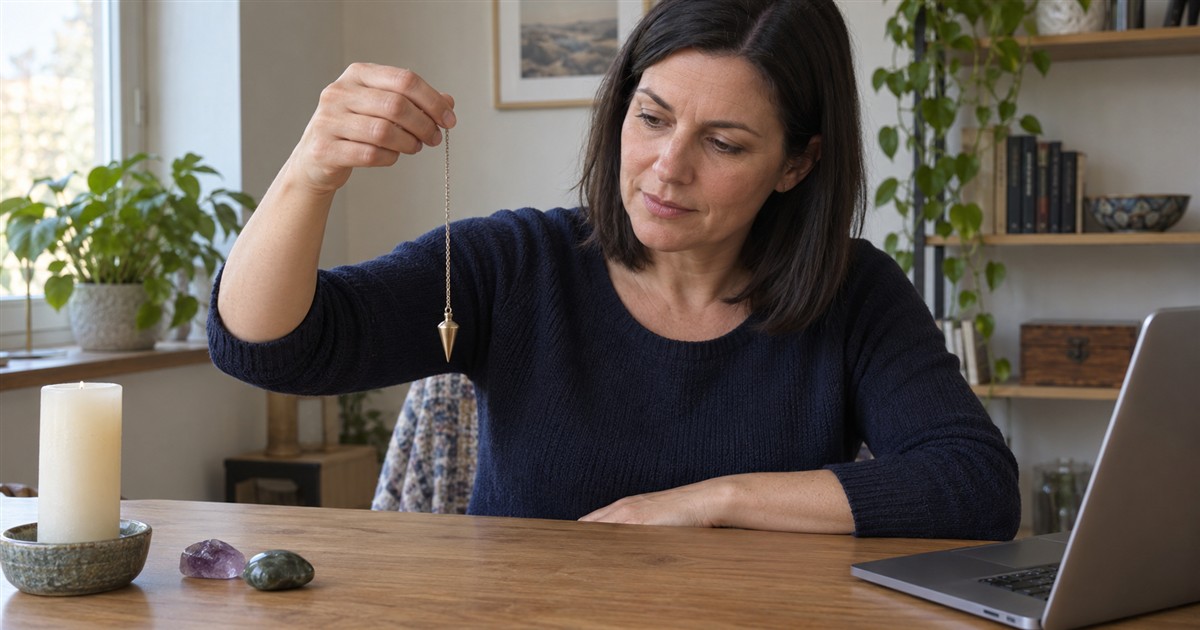
3. Pendulums: movement is not independent evidence
A yes-or-no movement can seem persuasive, but it should not be treated as a verified answer. The APA Dictionary describes ideomotor activity as movement related to thought that is produced without deliberate intention. Apparent lack of intention is not proof of an external source.
If you use a pendulum as a personal ritual, keep it low-stakes. Do not use it to decide whether to stop medicine, make a payment, accuse someone or bypass a boundary. An answer you want still needs ordinary information.
4. Scented oils: leave out generic skin instructions
A fragrance preference does not guarantee relaxation or psychic development. Do not apply an unspecified oil to your wrists because a generic meditation recipe says to. Product ingredients and intended uses differ.
The FDA’s aromatherapy guidance explains that “natural” plant ingredients can irritate skin or cause allergic reactions. Use appropriate product guidance and qualified advice for health concerns; a scent-free practice is always an option.
5. Incense: consider indoor air and other people
Incense is not required to receive a reading or perform a reflective exercise. Ask whether others sharing the space want smoke or fragrance, and choose a smoke-free alternative when that is more suitable.
The EPA’s indoor-particle guidance discusses combustion sources and ventilation when candles or incense are burned indoors. Removing a smoke source is different from declaring that smoke cleans an invisible energy. Our smudging guide covers further distinctions and limits.
6. Candles: a visual choice with fire precautions
Ordinary room lighting or a flameless candle can be a focus. An open flame is not necessary for a spiritual connection or a more accurate reading.
The NFPA candle-safety sheet advises stable holders, keeping candles at least one foot from things that can burn, and extinguishing them before leaving or going to bed. Do not follow a ritual that requires unattended burning.
Before adding a tool
Purpose
What ordinary role will it have—a reminder, focus or preferred setting?
Practical fit
Does it suit the space, other people and relevant safety limits?
Evidence limit
What would still need checking regardless of the tool?
Try less before buying more
A no-purchase version can be simple: choose a safe time to pause, use an ordinary focus, and write a brief note afterward if useful. Separate an impression from its interpretation and from any checkable fact.
Use the hunch-log guide to record specific statements before feedback, including misses. A pleasant experience or meaningful object is not a validation of paranormal accuracy.
Choose guidance that leaves room to stop
A mentor should explain the service, costs and limits rather than insist you buy tools to remain protected or become worthy of a gift. You are allowed to question a claim or leave a practice.
Review pressure and scam warning signs if purchases keep escalating. The tool should remain optional; your judgment should not be outsourced to it.
Frequently Asked Questions
1. Can these six tools guarantee psychic ability?
No. They may be used as optional elements of a reflective or spiritual practice, but ownership or use does not prove a gift or guarantee accurate information.
2. Do I need to buy a kit?
No. A simple no-purchase practice can use an ordinary focus and a brief note. A seller’s claim that expensive tools are necessary is not proof of need.
3. Must meditation last 15 to 20 minutes?
No fixed duration is required here. Choose a short period you can comfortably stop, and do not continue if it becomes distressing.
4. Does meditation require a blank mind?
No. Thoughts may arise. You can return to your chosen focus or stop without treating distraction as failure.
5. Can crystals restore dreams or sharpen visions?
Those are spiritual claims, not guaranteed effects established here. A stone may be a personal visual reminder without being a source of verified information.
6. Which crystal should I choose?
If you want one, choose it for personal meaning, appearance and practical handling—not a promised power. You can also skip crystals entirely.
7. Is a pendulum movement a reliable answer?
Do not treat it as independent factual evidence. Movement does not establish that an outside source answered, and it should not decide medical, financial or relationship matters.
8. What is ideomotor activity?
It refers to movement related to thoughts that occurs without deliberate intention. That is a reason not to assume that an apparently unplanned movement must have an external spiritual cause.
9. Should I put essential oil directly on my wrists?
Do not follow a generic drops-on-wrists instruction. Products and ingredients differ, and plant-derived fragrance can irritate skin or cause reactions. Follow appropriate product guidance or leave scent out.
10. Does natural or organic mean an oil is safe?
No. Those descriptions do not establish safety. FDA guidance notes that plant materials can be irritating or cause allergic reactions when used on skin.
11. Is incense required for a reading or meditation?
No. Smoke-free practice is an option. Incense should not be used to prove commitment, and indoor air quality and other people’s preferences matter.
12. Are candles necessary to create the right energy?
No. Ordinary light or a flameless candle can provide a visual focus without an open flame. Neither choice guarantees psychic information.
13. What are basic candle precautions?
Use a stable holder, keep the flame at least one foot from things that can burn, and extinguish it before leaving or sleeping. Follow fire-safety guidance rather than a ritual that requires unattended burning.
14. What should I record after using a tool?
Separate what you did, what impression arose and what can be checked. Include misses or unknowns rather than counting every event as confirmation.
15. How should I choose a mentor?
Look for clear limits, transparent terms and respect for questions and stopping. Avoid guarantees, secrecy, escalating fees or claims that you are unsafe without continued purchases.
The suggestions in the article are quite practical, especially for someone new to exploring their psychic abilities. The emphasis on meditation and grounding stones like rose quartz is sensible. Having a mentor for guidance is a particularly valuable recommendation.
The article presents a refreshing take on developing psychic abilities. I find the inclusion of both meditation and physical tools like stones and pendulum kits to be a well-rounded method. However, I would have liked more scientific backing on how these tools function.
While I remain skeptical about the effectiveness of stones and pendulums, I cannot deny the potential benefits of meditation for mental clarity and focus. Perhaps combining these methods with more empirical approaches could yield interesting results.
The idea that everyone possesses some level of natural psychic ability is intriguing. I appreciate the practical tips provided for enhancing these abilities. Meditation and the use of stones like lapis lazuli seem especially interesting. It’s a well-balanced approach to personal growth.
I appreciate the holistic perspective presented here. The use of oils, incense, and candles, along with meditation, creates a comprehensive regimen for enhancing psychic abilities. However, I would be cautious about relying too heavily on these tools without understanding their full impact.