


Quick guide
A reading can feel meaningful without being factually accurate. Assess a claim by what was actually said, how specific it was, what information the reader already had and whether the outcome can be checked. Do not explain away a wrong prediction by blaming your energy or attitude.
“That felt right” and “that statement was correct” answer different questions. A conversation may help you name a worry or consider an option. That benefit does not establish that the reader knew hidden facts or predicted an event.
There is no single accuracy percentage you can responsibly apply to all psychics, methods or appointments. A provider’s rating, confident delivery or collection of testimonials cannot supply that number.
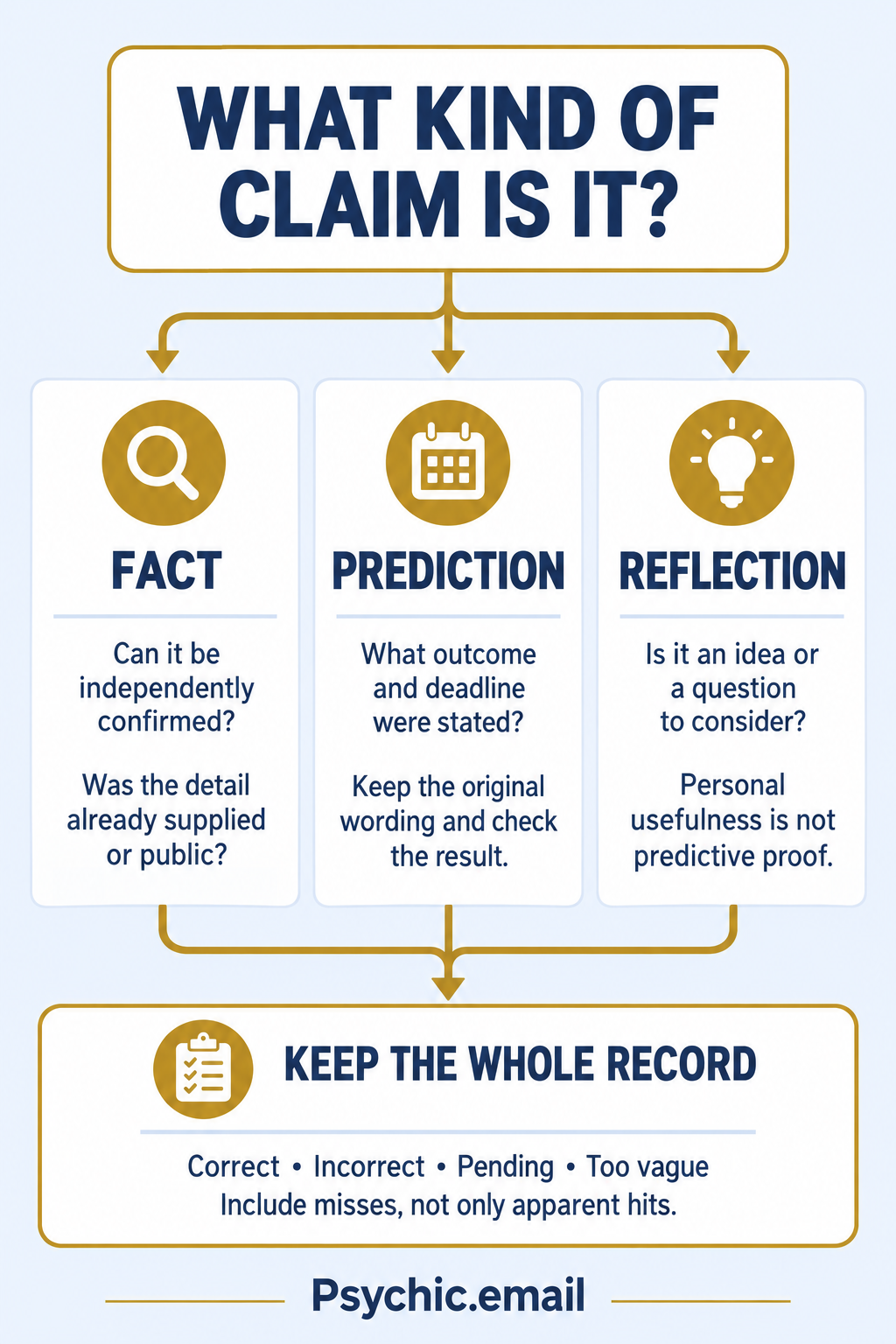
What would count as accuracy?
Begin with the type of statement. A present fact needs independent confirmation. A prediction needs a defined outcome and time frame. An interpretation or suggestion may not have an objective right-or-wrong answer at all.
Three statements, three different checks
Factual claim
“You changed jobs last April.” Was it correct, and had that detail already been supplied or made public?
Prediction
“An offer will arrive by Friday.” Keep the original deadline and record whether an offer actually arrived.
Reflection
“Think about what you need from work.” This can be a useful prompt, but it is not evidence of prediction.
These are illustrative examples, not statements from a tested reading. Changing a deadline after it passes or turning a specific claim into a metaphor makes it harder to evaluate fairly.
Why a broad statement may feel personal
The APA describes the Barnum effect as interpreting general descriptions or vague predictions as specifically applicable to yourself. For example, “You care about others but sometimes need time alone” can fit many people. Its relevance to you does not show that it was uniquely obtained about you.
Also consider information shared during the session. If you explain a relationship difficulty and the reader repeats its main features, that may show attentive listening rather than access to hidden information. A surprising detail deserves a careful look, but one apparent hit does not tell you how often the reader is wrong.
What controlled research can—and cannot—tell you
The APA’s definition of extrasensory perception notes that its existence remains controversial despite research. Individual mediumship studies have reported differing results: a triple-blind study published in 2022 reported positive results for its selected readings, while a controlled study of mediumistic writing published in 2020 found no advantage for target over control letters.
These studies used different tasks and participants. Neither result supplies an accuracy rate for a commercial reader you are considering. Consider the design, comparison conditions, sample and independent replication rather than treating a headline as a guarantee.
A fair way to review your own reading
If you choose to book, preserve the written response or make contemporaneous notes. Confirm permission and applicable requirements before recording a live session. A personal review can help you notice patterns; it is not a controlled scientific experiment.
- Keep the original wording. Do not replace it later with a more convenient interpretation.
- Separate individual claims. One sentence may contain several guesses, not one successful prediction.
- Note prior information. Include details you supplied or that were readily available.
- Set the check. Identify what fact, event or deadline would establish the outcome.
- Use honest categories. Record correct, incorrect, pending or too vague to assess.
- Retain every claim. Keep misses and ambiguous statements alongside apparent hits.
For instance, “Someone from your past may reach out sometime soon” lacks a clear person and deadline. Mark it too vague to assess rather than counting any future message as proof. Our impression-log guide discusses preserving the full record instead of remembering only matches.
Changing circumstances do not erase a failed prediction
Choices and outside events can change what happens. That does not make a wrong prediction correct. If a reader describes a conditional possibility, record the condition from the start. Adding “your energy changed” only after an outcome fails cannot independently verify the original claim.
You do not owe a reader unquestioning belief. Skepticism, distress or a difficult week does not make you responsible for inaccurate statements. A reading should not require you to accept a story about spiritual lessons before you can question it.
Use reflection without surrendering decisions
Keep advice proportionate to the evidence. Check consequential health, legal or financial matters through appropriate qualified help. Do not spend more money to repair a supposed blockage or secure a promised result.
Before booking, compare scope, privacy and payment terms. If a session becomes threatening or demands repeated payments, review the warning signs of psychic scams. You can stop, disagree or decide that no further reading is useful.
Frequently asked questions
1. How accurate are psychic readings?
There is no single verified accuracy percentage for every psychic or reading. Assess specific claims, the information already available and the outcomes, rather than assuming a rating establishes predictive accuracy.
2. Can a reading feel meaningful but be inaccurate?
Yes. A conversation can help you reflect or name a concern even when its factual statements or predictions are wrong. Personal usefulness and factual accuracy are separate questions.
3. What is the Barnum effect?
It is the tendency to interpret broad descriptions or vague predictions as personally specific. A statement that fits many people can feel tailored without showing unique knowledge about you.
4. Does a five-star rating prove accuracy?
No. A rating can reflect satisfaction, manner or perceived usefulness. It is not an independent controlled test of predictions and may not include all incorrect claims.
5. Does one correct detail prove psychic ability?
No. Consider prior information, specificity, chance and the full record of correct and incorrect statements. One apparent hit does not establish the explanation for it.
6. Should I tell a reader that a statement is wrong?
You may say so or simply note it for your own review. You do not need to find a hidden meaning to make the statement fit, and you may end an unhelpful session.
7. Can changing energy explain an incorrect prediction?
A claim about changed energy does not independently verify a failed prediction. If a prediction had conditions, those conditions should have been clear before the outcome, not added afterward.
8. Is skepticism responsible for a failed reading?
You should not be blamed for inaccurate claims because you were skeptical, distressed or unwilling to agree. You remain free to question a statement and decline further sessions.
9. How should I record predictions?
Keep the original wording, the time it was made, any stated conditions, the deadline and the observable outcome. Retain incorrect and ambiguous claims as well as apparent successes.
10. How do I assess a vague prediction?
If it lacks a clear event or time frame, mark it too vague to assess. Do not treat any loosely related event as confirmation or keep extending the deadline until something fits.
11. Can I count several guesses as one successful statement?
Separate the guesses where possible. A sentence with several details may contain both hits and misses. Counting only its successful part makes the record misleading.
12. Can a personal log scientifically prove accuracy?
No. A log can improve your own review but does not control for all explanations. Scientific testing requires suitable controls, clear scoring and independent assessment or replication.
13. Do mediumship studies guarantee a commercial reading will work?
No. Studies involve particular participants, tasks and conditions and have reported differing results. Their findings cannot be transferred into a guaranteed accuracy rate for an individual appointment.
14. Should I follow health or money advice from a reading?
Do not base consequential health, financial or legal decisions on psychic predictions. Use appropriate qualified help and reliable evidence, even if a reading felt convincing.
15. Do I need another reading to fix a wrong prediction?
No. You do not need to pay to repair claimed energy problems or make a failed prediction come true. Review what was said, check the terms and stop if the service is not useful.
The concept of energy being at the core of psychic readings makes a lot of sense. Our daily experiences indeed influence our energy, which in turn affects the insight we can gain from such readings.
I appreciate the emphasis on self-reflection and understanding one’s current situation before making informed decisions. It aligns well with the idea that personal growth is an ongoing process.
I find the approach of using a psychic reading as a tool for self-examination rather than future prediction intriguing. It’s a thoughtful perspective that highlights the importance of personal growth and reflection.
The notion that our future is shaped by our present actions and choices is a valuable reminder. It prompts us to be more mindful of our decisions and their potential long-term impacts.
The article underscores the complex interaction between our daily choices and our energy. It’s fascinating how our decisions can shape our future in unpredictable ways.