

Quick Guide
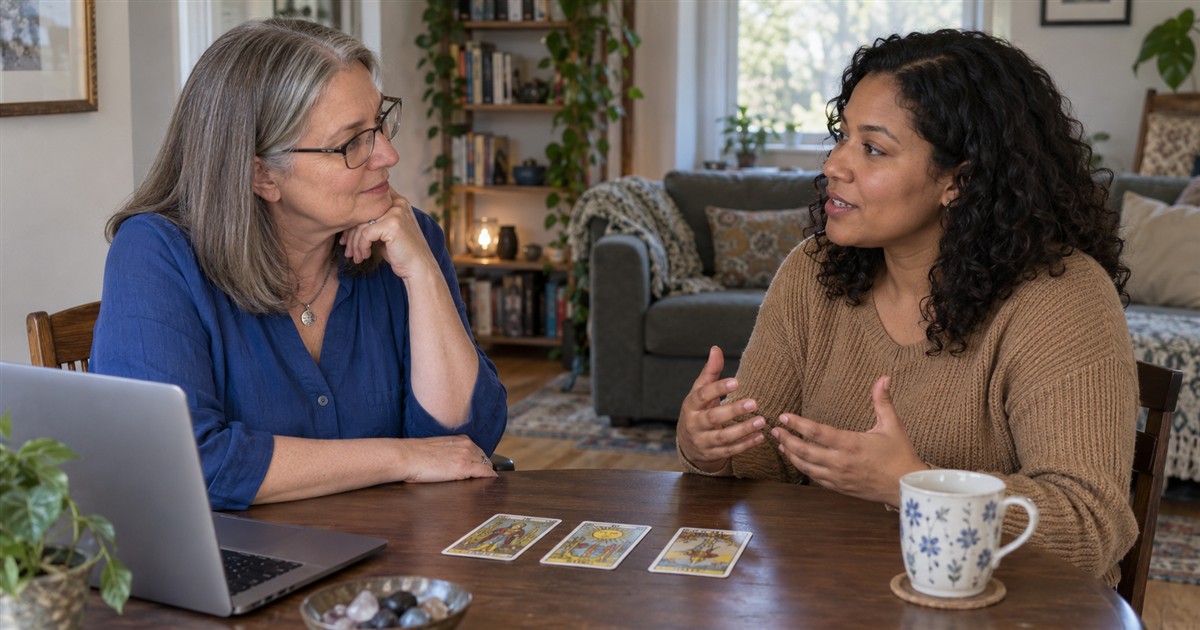
If you want to help someone through a psychic or reflective conversation, begin with consent and clear limits. Ask what support they want, label impressions as impressions and keep choices with them. Do not use claimed clairvoyance to diagnose illness, promise healing or direct high-stakes decisions.
Being helpful does not require certainty about hidden information. Listening, respecting a boundary and helping someone identify a practical next step can be more useful than presenting a vision as an answer they must follow.
Understand the claim without overstating it
Clairvoyance is used in psychic practice for claimed perception beyond ordinary sensory access, often described in visual terms. The APA Dictionary’s entry on extrasensory perception includes clairvoyance among alleged forms of awareness and notes that their existence remains controversial. A label does not verify a particular experience.
There is no basis here for saying that everyone has a psychic gift or that one in three people is clairvoyant. A statistic would need a traceable study, a clear definition and results that actually support it—not simply a memorable number.
Ask what kind of help is welcome
Start with an ordinary question: “Would you like me to listen, help with something practical or talk through some options?” If you also want to discuss a spiritual impression, ask separately. An agreement to talk is not permission for every topic.
Do not surprise someone with a prediction about death, illness, betrayal or a relationship. They do not owe you attention because you believe a message is important. A refusal ends the offer.
A consent-first support sequence
Ask
Find out what support the person wants and what is off limits.
Label
Separate an impression, an interpretation and an independently checked fact.
Return the choice
Leave them free to disagree, pause or decide differently.
Use questions rather than commands
Compare “I know your partner is lying” with “Is there a concern you want to clarify directly?” The first declares a private fact without evidence. The second leaves room for the person’s own knowledge and judgment.
Similarly, “You must quit your job because I saw a new future” is not a safe substitute for assessing commitments and options. A supportive conversation might instead ask what information they need before deciding. Consequential health, legal and financial matters need relevant qualified advice.
Keep a vision from becoming a diagnosis
Do not tell someone that an image identifies an illness, that an energy explanation makes medical care unnecessary or that you can guarantee healing at a distance. Do not suggest changing prescribed treatment on the basis of an impression.
If someone needs urgent assistance, help them reach the appropriate local service rather than delaying while you interpret the experience. Helping can mean staying within your limits.
Review your own impressions before offering certainty
A strong feeling, an image during meditation or a coincidental phone call does not establish a reliable ability. Informal guessing games can also be influenced by ordinary clues and by how broadly a statement is interpreted.
- Write first. Record the specific impression before feedback.
- Identify the check. State what could confirm or contradict the factual part.
- Include misses. Keep incorrect, ambiguous and uncheckable statements in the record.
- Consider ordinary information. Note what you already knew or could observe.
- Limit the conclusion. A casual match or another reader’s approval is not proof of paranormal ability.
The hunch-log and feedback guide gives a practical recording format. It does not turn a personal exercise into a scientific validation.
Respect third-party privacy
A person may agree to discuss their own choices without inviting claims about someone who is not present. Avoid presenting another person’s supposed thoughts as information you have a right to reveal.
If you use an email format, agree on the topic and limit unnecessary identifying details. See the email-reading privacy guide for what to leave out, and relationship questions that focus on the reader’s own participation.
If you charge, make the service understandable
State the format, topic, price, duration or written length, expected delivery and relevant terms. Do not imply that a longer session guarantees a more accurate prediction or that payment proves someone’s gift.
Reviews can describe an experience, but neither a favorable review nor a calm manner establishes psychic accuracy. The scam warning-sign guide explains why pressure, secrecy and escalating fees matter.
Measure help by the person’s needs
Ask whether the conversation was useful without pushing for praise or a testimonial. If they disagree with your interpretation, accept the correction. A helpful interaction should leave room for uncertainty and a practical choice—not require belief in your authority.
Frequently Asked Questions
1. What does clairvoyance mean in psychic practice?
It refers to a claimed ability to perceive information beyond ordinary sensory access, often described as images or visions. The term describes a claim, not a guarantee that information is accurate.
2. Does everyone have a psychic gift?
That is a spiritual belief, not an established fact about everyone. A person can be caring, observant or imaginative without identifying those qualities as paranormal.
3. Is the claim that one in three people is clairvoyant reliable?
Do not rely on that statistic without an identifiable study, a clear definition and evidence that supports the conclusion. It should not be used to tell someone they have a gift.
4. Can a strong mental image prove clairvoyance?
No. A vivid experience is not the same as an independently verified fact. Consider ordinary information, imagination, chance and alternative explanations.
5. Does someone calling after I thought of them prove a gift?
No. A coincidence alone does not establish clairvoyance. A fair comparison would include thoughts that were not followed by a call as well as apparent matches.
6. Should I share every impression with someone?
No. Ask whether they want to hear it, state that it is an impression and respect a refusal. Avoid alarming predictions or assertions about private facts.
7. What is a consent-first way to offer support?
Ask whether the person wants listening, practical help or an optional reflective conversation. Let them choose the topic and stop without pressure.
8. Can a reading tell someone what decision to make?
It should not replace their agency, factual information or qualified advice. Discuss questions and options rather than claiming that a vision obliges a particular choice.
9. Can clairvoyance diagnose illness or heal at a distance?
Do not use a claimed vision to diagnose, promise healing or advise changing treatment. Health concerns should be addressed by qualified clinicians.
10. Can I test a gift by guessing someone’s thoughts?
An informal guessing game does not establish paranormal ability. Prior knowledge, cues, chance, scoring and feedback all matter, and a friend should be free to decline.
11. Will a paid reading verify my abilities?
A reader’s opinion or a purchased certificate does not independently establish psychic ability. Do not assume that payment provides a reliable assessment.
12. How can I review an impression more fairly?
Write a specific statement before feedback, record how it will be checked and keep misses or uncertain outcomes. Avoid reshaping a statement after learning more.
13. Must a helpful reading last at least half an hour?
No fixed duration guarantees value or accuracy. Agree on the format, price and time beforehand, and keep the person free to stop.
14. Do reviews prove a reader’s predictions are true?
No. Reviews may describe customer experiences, but they do not establish paranormal accuracy or guarantee your result. Read written terms and assess pressure as well.
15. What if the person needs urgent help?
Do not delay appropriate professional or emergency support while interpreting a vision. Practical assistance can mean helping them reach the relevant service rather than offering a prediction.
It’s interesting to see how the perception of clairvoyance has evolved over time. The study suggesting that one in three people have this psychic gift is quite surprising.
The suggestion to test one’s clairvoyant abilities by guessing thoughts or seeking a psychic reading seems practical. It’s essential to approach this with an open but critical mind.
I agree. Self-testing can be a good starting point, but one should also be cautious about confirmation bias. Professional guidance might provide more reliable insights.
Yes, and it’s also important to ensure that psychics are reputable and have positive feedback from previous clients to avoid any potential deception.
The article makes a strong case for the potential benefits of clairvoyance, especially in guiding one’s personal and professional life. However, I’m curious about the scientific methods used to validate such claims.
The concept of generational transmission of psychic gifts, including clairvoyance, is intriguing. It would be beneficial to have more rigorous studies to understand the mechanisms behind such phenomena.
The emphasis on trusting one’s intuition while seeking clairvoyant readings is paramount. The balance between skepticism and open-mindedness can help one gain valuable insights without falling prey to unfounded beliefs.