


Quick Guide
Use intuition as a prompt to notice, ask and check—not as automatic proof. Record a specific hunch before the outcome, consider another explanation and use facts and appropriate advice for consequential decisions.
You might have a quick sense that a familiar task will take longer than planned or that a conversation needs a pause. Sometimes you can later explain the clues you noticed; sometimes the impression does not hold up. Both results matter.
A hunch is not the same as hidden knowledge
This guide uses intuition to mean a quick impression before you have fully stated your reasoning. It does not treat the impression as verified telepathy, clairvoyance or knowledge of the future.
In their paper “Conditions for Intuitive Expertise,” Daniel Kahneman and Gary Klein emphasize evaluating the predictability of the setting and the person’s opportunity to learn its patterns. That is different from assuming that every confident feeling is skilled intuition.
For example, experience with a recurring task may help you notice a familiar problem. A feeling about a stranger’s private intentions is a different claim and needs evidence of its own.
Notice, check, review
1. Notice
Describe the impression specifically, without declaring it a fact.
2. Check
Look for supporting information and a plausible alternative.
3. Review
Compare the original note with what happened, including misses.
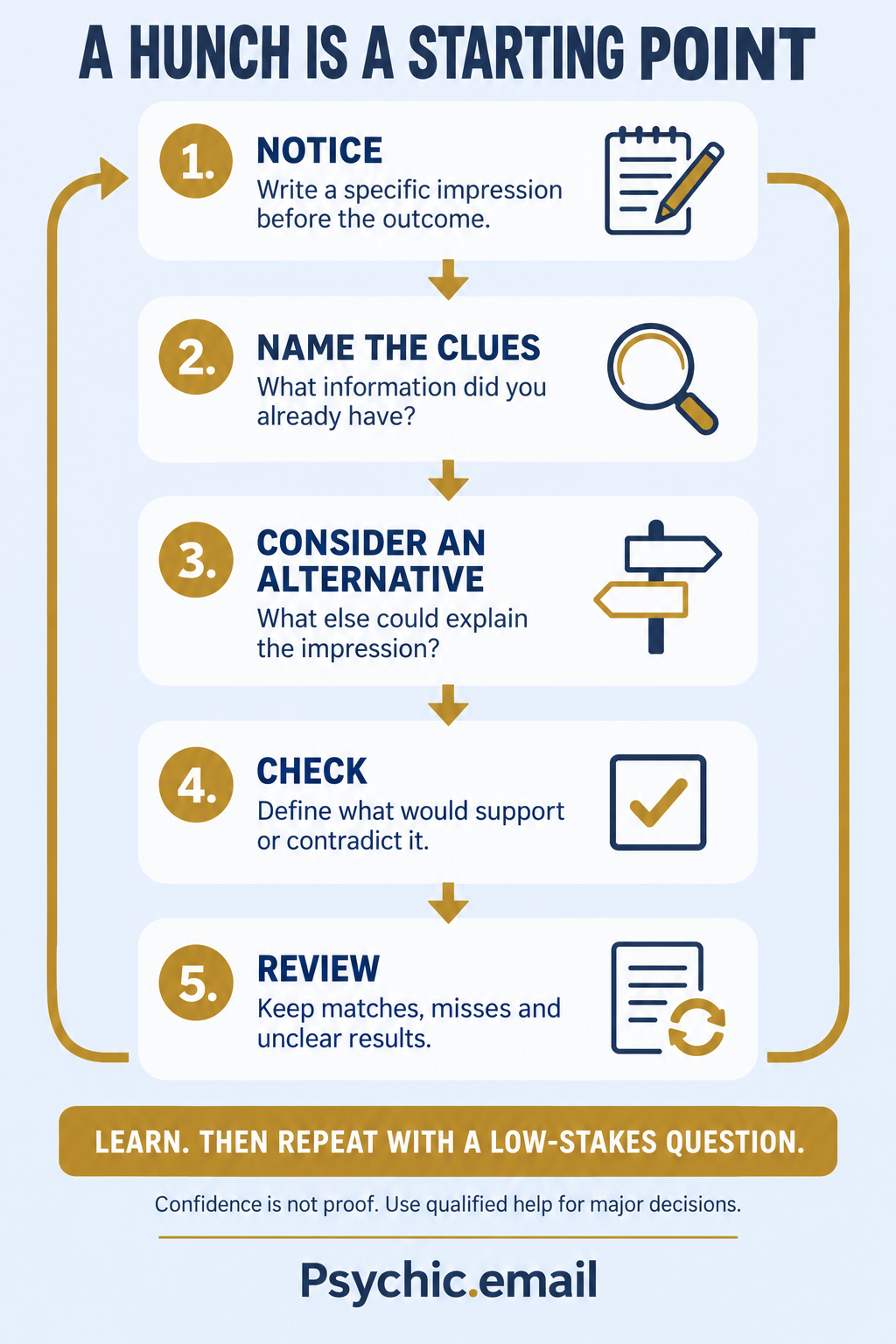
A limited everyday exercise
Choose a low-stakes, familiar situation rather than a health, financial or relationship accusation. For instance, before beginning a routine task, estimate which part may need extra time.
- Write the impression before doing the task.
- Note any clue you already have, such as missing material or a previous delay.
- Describe what would count as confirmation and what would not.
- Afterward, compare the result with the original note without changing its wording.
A note that says “something might go wrong sometime” is too vague to review. “Preparing the materials may take longer because one item is missing” is specific and may turn out to be ordinary reasoning. That is useful information, not a disappointing discovery.
Keep the misses and the uncertain results
If you save only the impressive outcomes, your record cannot show how often an impression was wrong or too vague to assess. Record “not supported” or “unclear” when that is the honest result.
Do not rewrite an unsuccessful prediction as a symbolic success after the event. Nor does a successful guess prove a supernatural mechanism. The exercise is for reviewing your judgment, not certifying a gift.
Use a question instead of mind-reading
If you think a friend is upset, try “Would you like to talk?” rather than “I know what you are feeling.” They may have another explanation or may not want to discuss it. Respect both possibilities.
In relationships, a feeling of jealousy or uncertainty does not reveal another person’s motive. Our guide to jealousy and observable behavior explains how to discuss conduct without turning it into an accusation.
Precaution does not require a proven prediction
If a situation feels uncomfortable, you can pause, leave or ask for support without claiming that you foresaw a specific event. A practical boundary can be about your comfort and safety.
That does not make every fear true. There is no dependable shortcut that says calm feelings are intuition and urgent feelings are anxiety. If trying to classify every sensation increases distress, stop the exercise and consider appropriate support.
Do not let a hunch replace qualified care
For symptoms, use healthcare advice rather than an intuitive diagnosis or a claim of blocked energy. For consequential legal or financial decisions, use the relevant facts and qualified guidance. A reading’s confidence does not make its answer a guarantee.
If spiritual advice has made you anxious, see our guide to responding after a distressing reading. You can keep curiosity while declining to treat an interpretation as established information.
Make intuition part of a decision, not all of it
Write the initial impression, then compare options, constraints and missing information. Ask what you would do if the hunch were wrong. A modest reversible step may be more appropriate than a large commitment.
Our practical planning guide offers a way to define the next action. Thoughtful judgment leaves room for both an initial impression and a correction.
15 Questions About Everyday Intuition
1. What is intuition in this guide?
It means a quick impression or hunch before you have fully explained your reasoning. It is a starting point to examine, not automatic knowledge of a hidden fact.
2. Is a strong feeling proof that I am right?
No. Confidence describes how a judgment feels, not whether it is accurate. Check what supports it and what could contradict it.
3. Does practicing intuition prove psychic ability?
No. Learning to review decisions does not establish clairvoyance, telepathy or knowledge of future events.
4. When might a hunch reflect experience?
It may reflect patterns learned in a familiar setting, but that possibility needs evaluation. The setting’s predictability and opportunities to learn matter.
5. How can I record a hunch fairly?
Write the specific impression, available evidence and what would count as a clear result before the outcome. Keep unsuccessful and unclear results as well as successful ones.
6. Should I record every thought?
No. Choose a limited low-stakes situation. Constant checking or turning every thought into a prediction can be unhelpful.
7. Can I tell what someone feels by intuition?
A hunch does not verify another person’s emotions. Ask a respectful question when appropriate and accept that they may not want to share.
8. What if a hunch tells me someone is dangerous?
You can take a practical precaution without proving their motive, such as leaving an uncomfortable situation. Do not convert the feeling into an unsupported accusation.
9. How do I separate intuition from anxiety?
There is no simple rule that reliably labels every feeling. Focus on the situation, observable evidence and appropriate support rather than judging by how calm or urgent the feeling seems.
10. Do dreams predict what will happen?
A dream is not reliable confirmation of a future event. If it suggests a concern, check the real-world issue rather than treating the dream as evidence.
11. Can I use intuition for medical decisions?
Do not use a hunch to diagnose symptoms or change treatment. Use qualified healthcare advice and respond appropriately to urgent concerns.
12. Should financial decisions rely on intuition alone?
No. Consequential choices need relevant information and appropriate advice, not a feeling of certainty or a psychic guarantee.
13. What does a wrong hunch mean?
It is an opportunity to review the judgment. It does not require inventing a hidden success, blaming another person or deciding that you lack worth.
14. Can I combine intuition with a checklist?
Yes. Note the impression, then check concrete factors and constraints. A hunch can prompt a question without becoming the final answer.
15. What if focusing on hunches increases distress?
Stop the exercise and seek appropriate support if needed. Developing a supposed gift is not more important than your everyday functioning or safety.
The concept of intuition as a naturally occurring skill that can be developed over time resonates with me. It highlights the importance of self-trust and the potential for growth in areas often overlooked. The practical examples listed are a useful addition.
I appreciate the emphasis on nurturing intuition as a valuable skill. It is akin to exercising a muscle that can enhance our ability to navigate complex situations and make informed decisions. The connection to both scientific and artistic inspiration is particularly noteworthy.
The article provides a thorough overview of intuition and its significance in human life. The idea that intuition is an instinctive part of our psyche and can be aligned with personal truth is thought-provoking. The focus on building confidence through intuition is also well articulated.
The article offers an interesting perspective on intuition and its practical applications in daily life. It reminds me of the importance of self-awareness and trusting one’s inner voice. Developing such a skill can indeed be beneficial across various fields.
The discussion on how intuition influences our lives and decision-making processes is quite compelling. It’s fascinating to consider how this innate ability can be honed and trusted to guide us towards better choices and a deeper understanding of our surroundings.