


Quick Guide
Choose a clearly stated name and calculation rule, list every selected vowel, add its letter value and reduce the total. The arithmetic can be checked; the interpretation remains symbolic, not a test that reveals your hidden motives.
A soul urge number, also called a heart’s desire number, is used in numerology to explore themes about personal wishes. You do not need to know it to understand yourself, and a description that sounds familiar does not establish that the number caused or uncovered your preferences.
The vowel-value chart
The common Pythagorean-style letter chart assigns A through Z repeating values from 1 to 9. The values relevant to this exercise are:
- A = 1
- E = 5
- I = 9
- O = 6
- U = 3
- Y = 7 when included under your chosen rule.
These are conventions for a symbolic calculation. They are not measurements of a person’s inner life.
State the rules before you add
For the examples here, use a full birth name, count A, E, I, O and U, and include Y if it functions as a vowel in that name’s pronunciation. Add all selected letter values across the name before reducing. Stop the digit reduction at a single digit, 11 or 22.
Other tools may handle these choices differently. For example, NumerologyCalc’s published name-calculator rules include a Y toggle and preserve 11, 22 and 33. This is an example of a provider’s convention, not scientific validation of its interpretations.
If a calculator disagrees, compare its instructions before trying to correct the total. Reducing individual name segments can also produce different intermediate results when special stopping numbers are retained.
Make the calculation auditable
1. Select letters
Write each vowel in order, including repetitions. Record your Y decision.
2. Add values
Show a subtotal for each name part, then add those subtotals.
3. Reduce consistently
Add the digits and apply the stopping rule you chose at the start.
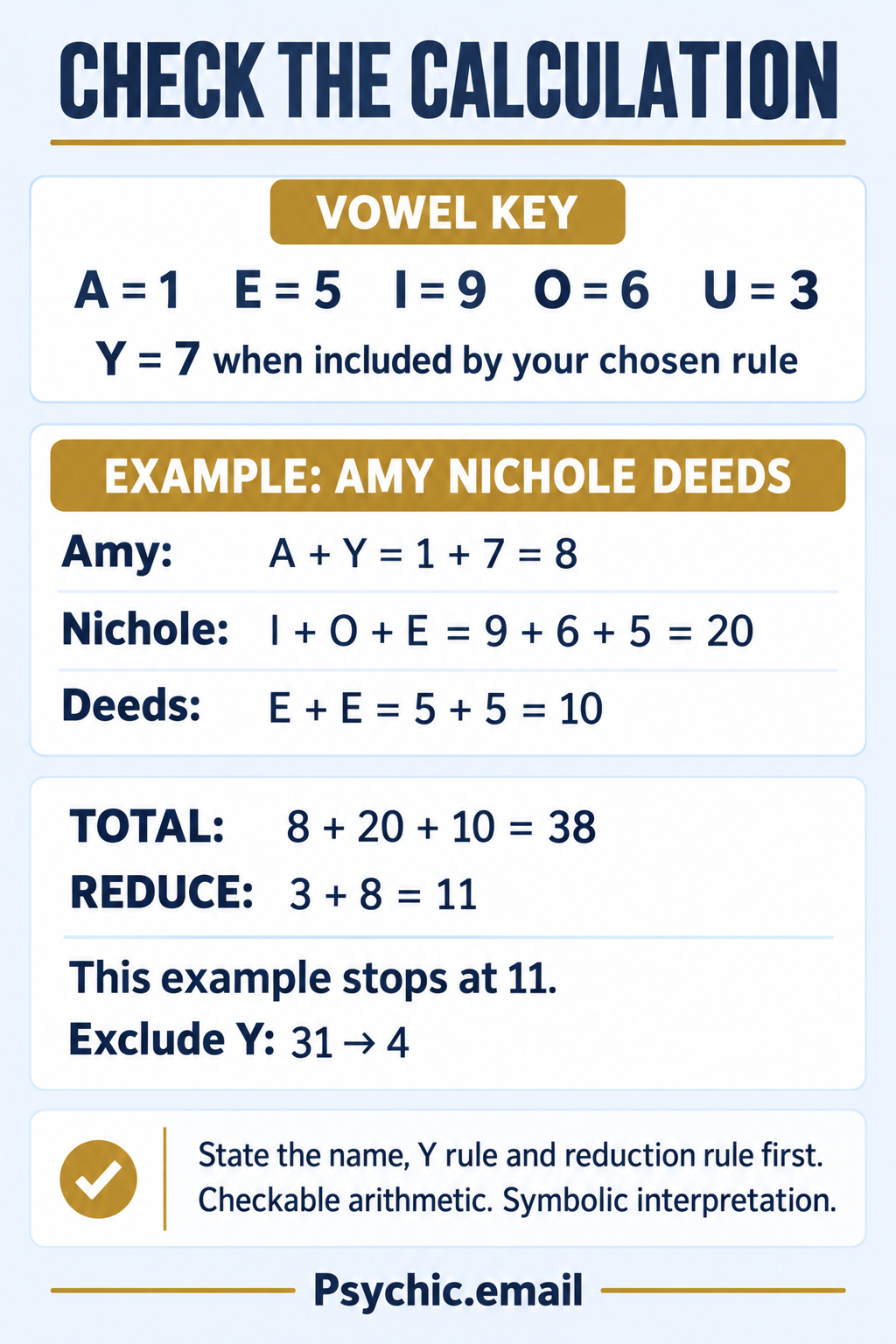
Worked example: Amy Nichole Deeds
This name is an arithmetic example, not a claim about a real person’s character. Including the final Y in Amy gives:
- Amy: A + Y = 1 + 7 = 8.
- Nichole: I + O + E = 9 + 6 + 5 = 20.
- Deeds: E + E = 5 + 5 = 10.
- Total: 8 + 20 + 10 = 38.
- Digit reduction: 3 + 8 = 11. Stop at 11 under this example’s rule.
If you exclude Y, the total is 31 and the single-digit result is 4. That difference follows from changing the input rule; it is not evidence of a changing soul.
Second example: Elena Rose Hart
Elena contributes E + E + A = 5 + 5 + 1 = 11. Rose contributes O + E = 6 + 5 = 11. Hart contributes A = 1. Using the whole-name addition method stated above gives 11 + 11 + 1 = 23, then 2 + 3 = 5.
Show the total before reducing so that someone else can reproduce your result. Do not quietly change a spelling or Y rule to obtain a number you prefer.
Names, accents and privacy
An A-to-Z chart does not automatically settle how to treat every language or name. If you remove accents or transliterate a name into Latin letters, record that choice. Different spellings can yield different values; do not describe one as a uniquely proven spiritual identity.
You can do the exercise on paper without submitting your full name to a website. If you choose a reading, the email privacy guide explains how to keep sensitive documents and account details out of a message.
Use a result as a question, not a verdict
A numerology description may suggest a theme such as independence, cooperation, creativity or responsibility. Ask whether the theme fits a current situation, and allow “no” as an answer. You do not owe an interpretation agreement simply because it was calculated correctly.
Try direct questions: Which commitment did I choose freely? What do I want time for? Am I asking for approval instead of deciding what matters to me? These questions can be useful with or without a number. Our guide to clarifying your desires develops that practical approach.
A number cannot tell you another person’s intentions. For a relationship concern, use direct conversation prompts rather than assigning a partner a motive from their name.
Frequently Asked Questions
1. What is a soul urge number?
In numerology, it is a name-based symbolic number often called the heart’s desire number. It is not an established test of your motives, personality or future.
2. Which letters count in the calculation?
The worked method here counts A, E, I, O and U, with Y included when it functions as a vowel in the chosen name. State your Y rule before calculating.
3. What values do the vowels have?
For the letter chart used here, A is 1, E is 5, I is 9, O is 6 and U is 3. Y has the value 7 when included.
4. Should I count every repeated vowel?
Yes. Count each occurrence in the name you are using. Two E letters contribute 5 plus 5, not just one value of 5.
5. Should I use my birth name or current name?
The worked method uses a full birth name. If you explore a current name separately, label it clearly rather than mixing letters from different versions.
6. Do spaces and hyphens add values?
No values are assigned to spaces or punctuation in this letter-based example. Keep the spelling clear so that no vowel is accidentally skipped.
7. Is Y always included?
No. Numerology methods and calculators differ in their treatment of Y. Record the rule you use and compare the inputs before assuming a different result is an arithmetic error.
8. How do I reduce the total?
Add the selected vowel values, then add the digits of the total. In the worked method here, stop at a single digit, 11 or 22.
9. What about the number 33?
Some numerology methods also preserve 33. The worked example here follows an 11-and-22 rule; state which rule you are using rather than switching halfway through.
10. Can two calculators give different results?
Yes. Check the spelling, Y treatment, handling of accents and whether name segments or the whole name are reduced. Different conventions can change the result.
11. Does the number reveal my true intentions?
No. A symbolic interpretation cannot establish your private motives. Consider your actual choices and ask yourself direct questions rather than treating the number as an authority.
12. Can a soul urge number prove compatibility?
No. It cannot establish what another person wants or whether a relationship is safe or workable. Direct conversation and behavior matter more than a number comparison.
13. Do I need to upload my birth certificate?
No document is needed for the arithmetic shown here. You can calculate privately on paper and should not upload identity documents simply to obtain a numerology result.
14. How should I handle a name written in another alphabet?
Choose and record a transliteration rule if you want to use this A-to-Z chart. Do not assume one spelling conversion gives a uniquely correct spiritual result.
15. How can I use the result without overrelying on it?
Treat it as a prompt to consider a question, then check your answer against experience. Do not use it to make medical, financial or other consequential decisions.
It’s intriguing how numerology assigns specific traits to numbers calculated from vowels in a name. This article could be a good starting point for those interested in exploring personal numerology.
This article offers an intriguing perspective on numerology, especially with the straightforward calculation method for soul urge numbers. However, more examples would have been beneficial for better understanding.
While the methodology seems clear, it would be interesting to see more scientific studies supporting these numerological claims. However, the guidelines for non-native English speakers regarding vowels were quite useful.
The concept of deriving personality insights from one’s name vowels is fascinating. The method provided is straightforward and could be an interesting exercise to understand oneself better.
The notion that numbers derived from vowels can reveal inner desires and motivations is quite thought-provoking. I appreciate the detailed steps for calculating the soul urge number.