


Email psychic reading times often depend on the reader, the service, and the agreement you make before booking a reading. There’s no one rule that every reading will arrive within a certain time period. A reader might offer a certain delivery window, arrange a deadline individually, or accept requests only when their schedule allows them to be free. The best question is whether the promised window is clear so that you can plan around it.
If you like spiritual guidance, waiting for a written reading can feel worth your time. You have a time frame to ask your question, and you can go back to the response later. This is a slower pace that allows room for uncertainty. An unanswered message might feel personal when the subject involves things like love, grief, or a hard decision, but the first thing to look at is what the service arrangement is instead of the spiritual meaning.
Delivery and interpretation are separate parts of the experience. Delivery is a practical commitment that can be checked; interpretation depends on the reader’s approach and your own judgment. Getting a message fast doesn’t mean that it’s more accurate, and a long wait doesn’t mean that the reader is getting more information.
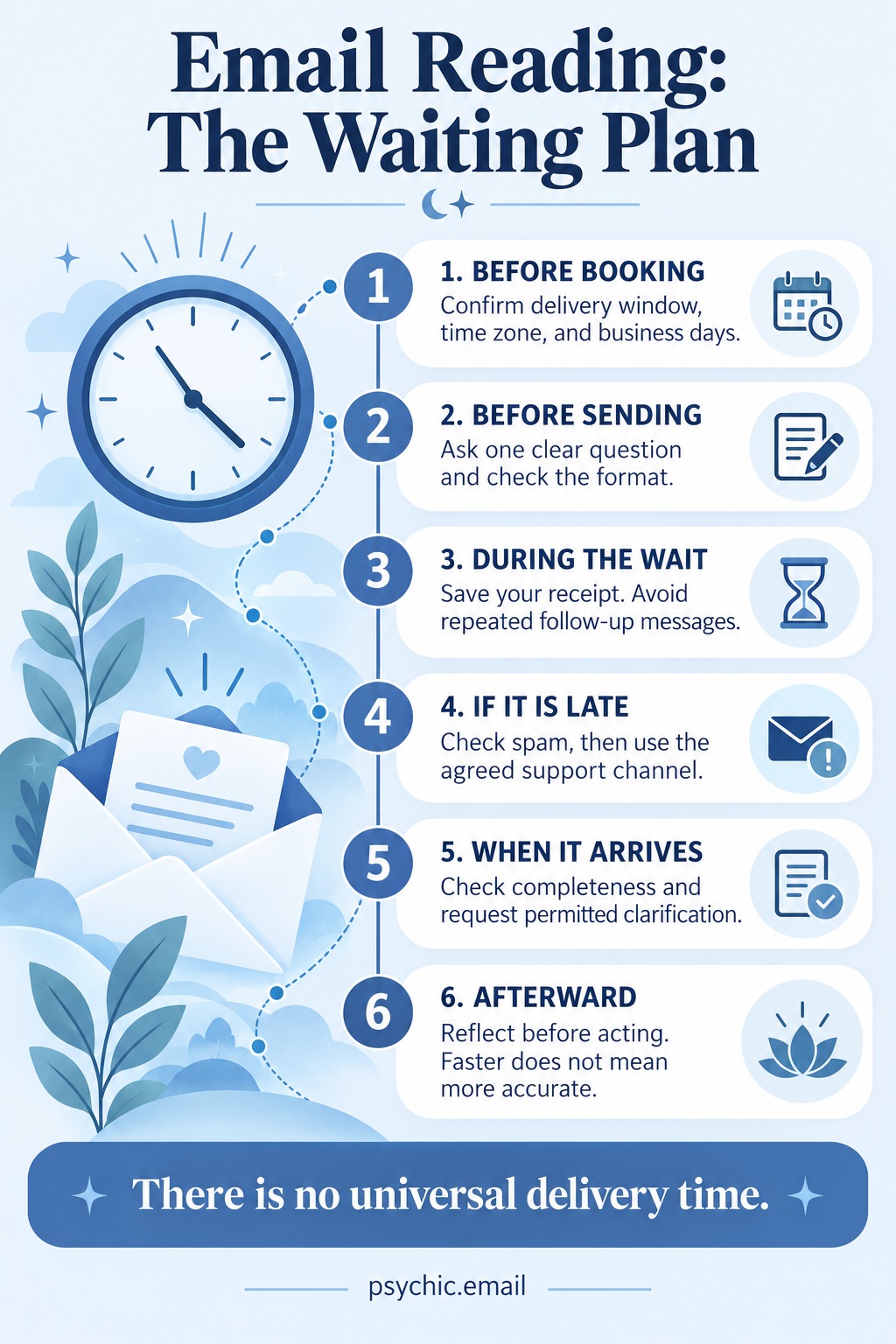
Read the infographic as text
- 1. BEFORE BOOKING: Confirm delivery window, time zone, and business days.
- 2. BEFORE SENDING: Ask one clear question and check the format.
- 3. DURING THE WAIT: Save your receipt. Avoid repeated follow-up messages.
- 4. IF IT IS LATE: Check spam, then use the agreed support channel.
- 5. WHEN IT ARRIVES: Check completeness and request permitted clarification.
- 6. AFTERWARD: Reflect before acting. Faster does not mean more accurate.
There is no universal delivery time.
Understanding an Email Reading
An email reading is a written response to one or more questions. Some readers will use tarot cards, astrology, or their intuitive impressions when giving a reading, while others combine different approaches. The answer can come in an ordinary email, an account inbox, a document, or some other format. This should be described in the listing. Make sure you clarify the format, since a platform notification and a reading might arrive from different places.
An introductory message is different from a paid reading. Asking if a reader accepts a clear question doesn’t mean that you’re in their reading queue. At the same time, paying for a service might create an order without starting the work if the reader still needs the question or information that’s said in the offer.
Keen’s Mail help page provides one concrete example. It describes regular and paid messages and explains that some advisors offer readings through Mail. Its response-time guidance leaves room for individual advisors to manage their businesses differently. That is a platform example, not a promise about every reader or every website.
Before booking, decide what the fees cover: a complete reading, a reply to one question, access to messages already there, or something else. These things can create different expectations, even if it’s called an email reading.
Response Times
A delivery promise is helpful when you understand the starting point. Does the reader count from the payment, acceptance of the order, when they get the question, or the next working day? If it says, “within 3 business days,” it needs more context.
Ask which days the reader works and what time zones work with the deadline. If the listing doesn’t tell you this, ask a question. You might say, “Before I order, can you tell me the delivery window, when it begins, and if weekends count?” This question helps to avoid unnecessary disputes.
Think of an illustrative booking that you make late on Friday. If the reader only works Monday through Friday, they might not start counting until Monday. Another reader might count calendar days from the time of payment. Neither arrangement needs to be assumed. Public holidays can add another difference in the situation, along with readers who live in different countries.
You can keep a small order note that has the start conditions, the delivery window, and the expected date that you’ll get it. This is helpful if you’re comparing different services. It takes the feeling of waiting and turns it into a record that you can look at without always checking your inbox.
Understanding Delivery Claims
Words such as priority, comic express, and same day need better definitions. A priority delivery might mean that you’re put ahead of standard orders, but it does not guarantee a certain hour. Same-day might only apply to requests that happen before a certain cutoff time. An express option might also exclude follow-up questions.
Make sure you look for a full description instead of just thinking of it as a regular agreement. Ask what happens if the promised delivery window gets missed. Find out if there’s an update, a refund process, or a different reader, or if you can decline or accept the reading after the deadline. Knowing the policy gives you a way to move forward.
FTC's online shopping guidance recommends checking terms and keeping records of transactions and communications. Its general consumer advice is useful when purchasing an online service too. Specific rights and payment remedies vary by location and arrangement, so avoid assuming that a policy for physical goods automatically governs your reading.
Always be careful about paying a rush fee for questions that can’t wait safely. A medical concern, legal deadline, or safety problem needs the right kind of professional help or emergency resources. A spiritual reading can still be a separate source of reflection when the answer doesn’t have to be so urgent.
Ask a Clear Question From the Beginning
A clear question can make it much easier for the reader to understand what you’re looking for. Try to focus on the main subject, what kind of guidance or reflection you want, and anything important the reader should know. For example, “What can I reflect on before talking with my manager about a change in my responsibilities?” gives the reader a clearer direction than one long message that combines work, family, money, and a former relationship.
You don’t need to share your entire life story either. Give the reader the information that seems important for the type of reading you purchased and whatever you feel comfortable sharing. If you’re asking for a dream interpretation, you might describe what happened in the dream, how you felt, and what you’re hoping to understand about it. You usually won’t need to include private details about other people unless they’re actually important to the question.
For example, a client might write, “I dreamed that I couldn’t find the door to my workplace. I felt frustrated instead of afraid. I’d like a symbolic reading about what this might connect with in my current sense of direction.” This gives the reader plenty to begin working with without including things like an employer’s address or a coworker’s full name.
Before sending more questions, check what was included with the reading you purchased. Some readers might include a clarification, while others might charge for more questions or treat them as another reading. If another subject comes to mind after the reading has already started, you can always save it for another time instead of changing the original question completely.
Make the Wait Feel a Little Easier
Pick a checking routine that makes sense for the delivery time you were given. If your reading is expected within several working days, checking your inbox every few minutes probably isn’t going to make it arrive any faster. Checking once or twice during the day might be enough. Keep your receipt or order information somewhere easy to find so you can quickly check the expected delivery date if you need it.
While you’re waiting, write down what you already know about the situation. You might include what has already happened, the choices you’re considering, how you feel about them, and anything you’re still unsure about. When your reading arrives, you’ll have something to compare it with and can think about how the reader’s guidance connects with what you’ve already been considering.
You can also continue with spiritual practices that help you feel connected while you wait. You might journal, meditate, spend some time outside, work with your crystals, pull your own tarot or oracle card, or reflect on a dream that has stayed with you. The waiting period can become part of your reflection instead of just feeling like time spent watching your inbox.
At the same time, everyday life doesn’t have to stop while you’re waiting for a reading. You can continue filling out the job application, prepare for an important conversation, take care of responsibilities, or follow your normal routine. When the reading arrives, you can then bring its guidance into everything you’ve already been thinking about and decide what feels meaningful and useful for you.
If the Deadline Passes
If the deadline passes, you need to first check the agreed delivery location, your spam folder, your inbox, and any place where the missing information could be. Make sure the payment was completed and the order was actually accepted. These are practical ways to make sure everything was ready before the deadline passed.
Send a follow-up through the regular channel. You might say something like, “My reading was accepted, and the window was supposed to be 3 business days. The window has passed, and I haven’t received a response. Please confirm the status and the available options.” If there’s a reference order, write it down, and don’t send sensitive details.
Allow the response stated in the support policy. If you don’t get a response, ask for an update instead of repeatedly sending messages. Keep copies of your messages, and if the reader gives a new deadline, find out if this still works for you before you agree to it.
If there’s no response, use the complaint or payment support process found on the site. Explain the commitment and the missed delivery. A clear record of what was purchased is better than arguing about whether the reader’s spiritual abilities are real. Follow the dispute deadlines provided by the payment service.
Privacy Matters
An email reading can be a lasting written record. Think about where it’s stored, who can access the account, and whether the device is shared. The sender’s address might be seen in an ordinary email, even if there’s a messaging system that handles the context differently.
FTC's guidance on protecting personal information explains practical account-security measures. For your reading, use a strong account password and available multifactor authentication. Avoid sending payment-card numbers, account passwords, identification documents, or medical records inside the reading request.
If a service asks for a birthday or a picture, find out why they’re asking for that and whether there’s an alternative. Requirements can be different depending on the reading method. A claim that sending more private information will make the reply come faster needs a real explanation instead of an automatic agreement.
Make sure you’re careful when you forward answers to a friend. A reading about a relationship can have private details that you don’t want anyone else to see. You could talk about what you learned without giving the complete message. Privacy is part of respectful spiritual practices, both before and after the reading.
What to Look for When Your Reading Arrives
Read the message once to get the overall meaning, and then go through it again to look at the details. Think about if the reader actually answered the question you paid for. Look at how clearly unfamiliar terms are explained and if the reader separates spiritual guidance or reflection from things they claim will definitely happen. A long reading can still be vague, while a shorter reading might give you a clear answer to a carefully focused question.
If part of the reading is confusing, use a clarification option if one is included. Keep your question focused on the part you didn’t understand instead of adding several new questions. For example, you might ask, “When you mention hesitation, are you talking about something you noticed in the cards or something I shared with you?” This gives the reader a chance to explain what they meant without turning the clarification into another reading.
You can also like the way a reading was delivered without feeling like every prediction has already been proven. A reader might communicate thoughtfully, give you something meaningful to reflect on, or help you look at a situation differently. Future predictions can still be left open until enough time has passed to see what actually happens. If you want to look back at the reading later, save the original message so you can compare it with what happens over time.
If the response immediately pressures you to purchase another reading or service, give yourself time before spending more money. A completed reading should make sense within the scope you originally agreed to. You can ask for clarification if something is confusing, decline another purchase, or decide that the reader just isn’t a good fit for you.
An Easy Example of How This Might Work
Imagine Maya wants a written reading because she’s preparing for a difficult conversation with a family member. The listing includes one focused question and says the reading will be delivered within four business days after the order is accepted. Before paying, she confirms that the reading will arrive in her account inbox and that one short clarification is included.
Maya saves the information about what she purchased, sends one clear question, and decides to check her inbox once each evening instead of constantly looking for the response. While she waits, she writes down what she hopes to accomplish during the family conversation. When her reading arrives, the reader suggests that listening could be important. Maya uses that suggestion as something to reflect on and then thinks about how it might fit the actual situation.
If the reading arrives late, Maya has the original delivery information to look back at before contacting the reader. If the reading predicts exactly how the family member will react, she can keep that prediction in mind without just thinking that it guarantees what the other person will say or do. The family member still gets to speak for themselves when the conversation actually happens.
This kind of approach can help protect Maya’s time and money while still giving her plenty of room to enjoy the spiritual side of the reading and decide what feels meaningful to her.
Setting the Pace
The best response time is one that describes your needs. A slower written format can work if you need time to reflect, and a live reading can fit better if you need immediate clarification and can manage the calls.
Before you book a reading, confirm the start conditions, deadline, delivery channel, and questions. After the booking, make sure you keep the agreement and continue in your everyday life. This helps an email psychic reading stay a thoughtful experience instead of an open-ended wait for certainty.
Final Thoughts: Checking the Format
If you’re someone who uses a screen reader, enlarged text, or translation support, ask how the reading will be delivered before you make the purchase. A plain written response might be easier to read than an image with a lot of text or a scanned handwritten page. The format needs to help you understand the answer and not create a barrier.
If the reader gives you an attachment, make sure you can open it in a trusted account on a trusted device. You can ask for an ordinary text message when available. A delayed reading or files that are unreadable are service concerns, so make sure you talk about the problem accurately when you contact support.
These questions can be helpful for anyone who wants a certain reading format. Clear delivery works when the response comes, and you are actually able to read and revisit it comfortably.